
8 Unforgettable Styles of Funny Rhymes for Birthdays (2026 Edition)
Stuck in a rut writing the same old birthday message? This year, ditch the clichés and learn how to create genuinely funny rhymes for birthdays th


Jan 16, 2026 | 17 Min Read
When a member of your team is going through a loss, a thoughtful condolence message from company leadership is more than just good etiquette—it’s a powerful act of compassion. It shows you see your employees as people first, not just as workers. This simple gesture goes a long way in building a genuinely supportive culture and can make a real difference to team morale.

Acknowledging grief isn't just another box to tick on an HR checklist. It’s a core part of building a team that’s both compassionate and resilient. For an employee navigating the turmoil of loss, a message from their employer can be a small but vital anchor of stability.
Honestly, it's an act of kindness that speaks volumes. It sends a clear signal that the company cares about its people beyond their professional output. Ignoring such a major life event can make an employee feel completely isolated and undervalued, which almost always leads to disengagement.
A sincere message of sympathy is a building block for psychological safety, creating an atmosphere where people feel they can be vulnerable without judgement. When leaders and colleagues openly acknowledge personal hardship, it reinforces that the workplace is a safe space to handle life's curveballs. This is especially crucial for remote and hybrid teams, where it’s all too easy for those personal connections to feel a bit stretched.
A coordinated, empathetic response transforms a corporate duty into a genuine expression of collective support. It shows that beneath the structure of business, there is a community of people who care for one another.
While a note from leadership is essential, a collective gesture from the whole team often has an even bigger personal impact. Getting everyone together to sign a group greeting card or a digital ecard is a fantastic way for colleagues across different locations—whether they're in the United kingdom, United states, Australia, Canada, India and Africa—to share their own personal messages and memories. A great kudoboard alternative, it makes collaboration simple.
This team approach really pays off:
At the end of the day, handling these moments with care shows your company culture is built on something real: empathy, respect, and human connection.
When you’re writing a company condolence message, getting the tone right is everything. This isn't just another corporate email; it's a moment that calls for real human empathy, balanced with professional respect. The aim is to offer genuine comfort, not to tick a box with a formal, impersonal memo.
The single most important thing is authenticity. Your message needs to come from a place of real care, not just obligation. That means steering clear of tired clichés and overly stiff language that can make you sound distant. Think warmth and sincerity.
The trick is to be supportive without being intrusive. You should acknowledge how difficult the situation is, but do it respectfully. Often, the simplest, most heartfelt words are the ones that land best.
See the difference? The second one feels more personal and immediate. It comes from people who care, not a faceless company. If you’re looking for more ways to phrase your thoughts, these inspiring examples of letters of grief can be a great starting point.
No two losses are the same, so your message shouldn't be either. It needs to reflect the specific circumstances and your relationship with the employee. What you write for a colleague who has lost a parent will be very different from a message to the family of a team member who has passed away.
Choose your words carefully. Phrases like, "I can't imagine what you're going through," show empathy without pretending you know exactly how they feel. And instead of a vague "let me know if you need anything," offering specific, practical help is far more meaningful. For more detailed ideas on what to write, check out our guide on what to say in a sympathy card.
It’s easy to forget just how common bereavement is in the workplace. Every year, over 600,000 people die in the UK, leaving more than six million people grieving. These aren't just numbers; they represent colleagues, friends, and team members who are hurting. Handling these situations with compassion is a huge responsibility for any company.
A truly supportive tone is one that listens more than it speaks. It offers a steady presence, respects privacy, and communicates that the employee is a valued member of a caring community, especially during their most vulnerable moments.

When you’re trying to put words to something as difficult as a loss, structure can be your best friend. A thoughtfully organised message ensures your words come across as clear, comforting, and genuinely supportive.
This isn’t about being robotic or following a rigid script. Think of it more as a roadmap to help you express your sympathy without adding any extra confusion or stress. Breaking your message into four key parts—the opening, a personal acknowledgement, a real offer of support, and a warm closing—helps create a message that feels both complete and compassionate.
Get straight to the point, but with warmth. Your very first line should express your sorrow for their loss. This is a time to skip the corporate jargon or tired clichés; a simple, heartfelt statement always lands best.
That first sentence immediately sets a supportive tone and lets your colleague know you’re thinking of them.
The next part is where you can make the message truly personal. This is your chance to acknowledge the person who has passed or recognise the weight of the employee's grief. If it’s a team member who has died, sharing a brief, positive memory or mentioning their impact on the company can mean the world to their family.
Saying something specific, like "We will always remember [Name]'s wonderful sense of humour around the office," is far more powerful than a generic platitude. This principle of personalisation is key in many professional communications, including when you write a farewell message to staff, as it shows genuine thought.
A great condolence message honours the individual by sharing something specific and positive. It shifts the focus from the loss to the person’s valued legacy, offering a moment of warmth amidst the sadness.
This might be the most critical part of a company condolence message. The classic "let us know if you need anything" is well-intentioned, but it puts the burden on the grieving person to figure out what they need and ask for it. A much better approach is to offer specific, practical help.
Think about what would actually make a difference:
These kinds of offers are actionable and prove you’ve genuinely thought about their immediate needs. For more ideas on getting the sentiment just right, there are some great strategies for writing effective sympathy cards that can help.
End your message by circling back to your support and offering warm wishes. This final sentence should leave the recipient feeling cared for and reminded that they’re part of a supportive community.
Simple, sincere phrases work best here:
Following this simple flow ensures your message is thoughtful, supportive, and truly helpful when your colleague needs it most.
To help you navigate this, here's a quick reference table breaking down the dos and don'ts for each part of your message.
A breakdown of the essential parts of a condolence message, with do's and don'ts for each stage to ensure a supportive and professional tone.
| Component | What to Do | What to Avoid |
|---|---|---|
| Opening | Be direct, sincere, and express sorrow immediately. | Using clichés like "I know how you feel" or overly formal language. |
| Acknowledgement | Share a positive, specific memory or quality of the person. | Making generic statements or focusing too much on work. |
| Offer of Support | Provide specific, actionable help (e.g., covering work, EAP info). | Vague offers like "Let me know if you need anything." |
| Closing | Reiterate your sympathy with a warm, simple closing. | Ending abruptly or with a business-like sign-off. |
Keeping these simple guidelines in mind will help you write a message that provides real comfort and support.
Finding the right words when offering condolences is tough. It's one of the hardest things we have to do. The situation dictates everything—the tone, the level of formality, and how personal you should get.
To help you out, here are a few practical examples you can adapt. Think of them as a starting point. The best messages will always have a personal touch that reflects your company’s culture and your actual relationship with the person.
When you lose a team member, the message is usually addressed to their family. The aim here is to convey your collective sorrow, celebrate the person you knew, and offer genuine support to their loved ones.
Example Message:
Subject: With Deepest Sympathy from [Company Name]
Dear [Family's Name],
We are all heartbroken to learn of [Employee's Name]'s passing. Words can't express how sorry we are for your loss.
[Employee's Name] wasn't just a colleague; they were a friend and a vital part of our team for [Number] years. We'll always remember their incredible [positive quality, e.g., sense of humour, dedication to helping others, brilliant creativity]. Their work on [specific project or team goal] made a real difference and will not be forgotten.
Please know that all of us are thinking of you during this incredibly difficult time. We share in your grief and are here to support you however we can.
With our deepest condolences,
The Team at [Company Name]
In this case, your message is for the employee who has lost someone close. The focus shifts to empathy, practical support (like taking work off their plate), and simply letting them know their team cares.
Example Message:
Subject: Thinking of You
Dear [Employee's Name],
We were so deeply saddened to hear about the loss of your [Relationship, e.g., father, grandmother]. Please accept our heartfelt sympathies.
We can only imagine how difficult this must be for you and your family. The most important thing is for you to take all the time you need, so please don't worry about anything at work. The team has it all covered.
We're all thinking of you and sending you strength.
With deepest sympathy,
[Your Name/Team Name]
A quick tip: The most helpful messages offer specific, concrete support. Instead of a vague "let me know if you need anything," clearly state how you'll handle their responsibilities. It removes one less worry from their mind.
It’s a truly thoughtful gesture to acknowledge the passing of someone who used to work with you. It shows that people are valued beyond their time at the company. This kind of message can be sent to the family or shared internally with staff who knew them well. If you're struggling to find the right phrasing, these examples of "sorry for your loss" messages might offer some inspiration.
Example Message:
Subject: Remembering [Former Employee's Name]
Dear Team,
It is with great sadness that we share the news of the passing of our former colleague, [Former Employee's Name]. Many of you will remember [Him/Her] from their time in the [Department] department between [Year] and [Year].
[He/She] was such a valued member of our community, known for [mention a positive trait or memory, e.g., their infectious enthusiasm and passion for their work]. [He/She] certainly left a lasting impression on us all.
Our thoughts are with [His/Her] family and friends during this time.
Sincerely,
[Your Name]
How you send a condolence message is often just as meaningful as what you write. Getting the delivery right shows your support is timely, thoughtful, and respects what your colleague is going through. The best choice usually comes down to your team’s setup—whether you’re in the office, remote, or a mix of both.
A quick email from a manager or HR is a good first step. It's immediate, private, and acknowledges the situation straight away. Traditionally, a physical card passed around the office would follow, but let's be honest, that’s a real challenge for remote and hybrid teams. How do you get everyone to sign it?
This flowchart can help you decide on the most fitting way to show you care.
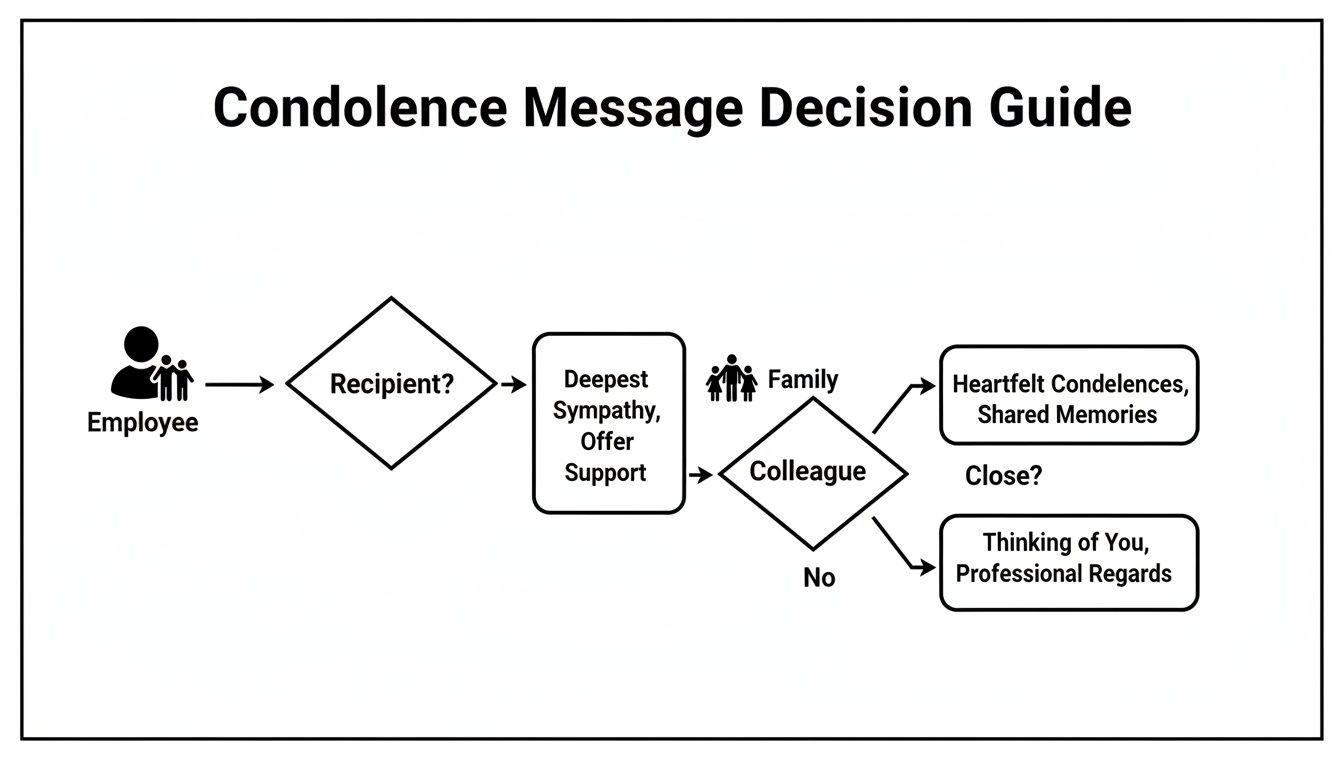
As you can see, the best approach really depends on who you're supporting—a grieving employee, their family, or the entire team after a shared loss.
For teams spread across the United Kingdom, the United States, or Australia, digital platforms have become a lifeline. A group greeting card online effortlessly closes the distance, making it simple for every single person to add their own message and show their support in one place.
A digital card isn’t just about making life easier; it's about being inclusive. It guarantees every colleague, no matter their location, has the chance to express their sympathy. This makes the grieving employee feel the full strength of the team behind them.
Modern tools like Firacard have completely changed the game for offering collective support. Instead of chasing down signatures for a physical card, a group online card can be set up and shared in minutes. People can add personal messages, share photos, and even drop in a thoughtful GIF, creating a warm, multimedia keepsake the recipient can look back on whenever they need to. You can learn more about the practical benefits of using digital cards for work right here.
This approach is especially powerful in uncertain times. In the UK, company insolvencies hit 25,158 in 2023—the highest they've been since 1993. When things are unstable, maintaining team connection is more important than ever. Collaborative digital condolences are a small but vital way to keep that cohesion strong.
A virtual leaving card or sympathy card helps the whole team come together to share memories and offer comfort, ensuring no one feels left out of the gesture.
When a colleague is grieving, it’s completely normal to feel a bit lost about what to do or say. You want to be supportive, but you’re also worried about saying the wrong thing. Let’s tackle some of the most common questions that pop up for managers and teammates in these tough situations.
Honestly, a combination approach is usually the most heartfelt and effective. The company should send an official message, typically from a senior leader or the HR department, to formally acknowledge the loss on behalf of the organisation.
But just as important—if not more so—is a personal message from the employee's direct manager and their immediate team. This is where the real, personal connection lies. A group greeting card is brilliant for this. It lets you combine the official company sentiment with genuine, individual messages from the people they work with day-to-day, all in one meaningful keepsake.
It’s almost always best to steer clear of mentioning the cause of death. The only time you should even consider it is if the family has publicly shared the information themselves, and you are 100% certain it's okay to echo it.
Think about it: the whole point of a condolence message is to offer comfort and support. Digging into the specifics of how someone passed away can feel intrusive and distracts from the core message of sympathy. Your top priority should always be the family's privacy.
The core of a supportive message is empathy, not explanation. Your goal is simply to let the grieving person know they are not alone and that their work community cares for them.
It doesn’t matter. Your role as a colleague or manager is to show you care on behalf of the whole team and the company. You don't need to have been best friends to offer sincere sympathy and acknowledge the loss.
Keep your message simple, warm, and genuine. You can focus on their positive contribution to the team or how they were a valued part of the organisation. A simple, "We were all so sorry to hear of your loss. [Name] was a valued member of our team, and we are thinking of you," is respectful, supportive, and shows you care.
This is where technology really helps. For teams scattered across the United kingdom, United states, Australia, Canada, India and Africa, passing a physical card around the office just isn't going to happen.
This is exactly why digital platforms like Firacard were created. You can set up a group online card in seconds. Just share the link via email or your team's chat channel, and everyone can jump in to add their own message, a nice photo, or even a GIF from wherever they are in the world. As a leading groupgreeting alternative, it cuts out all the logistical headaches and ensures everyone gets a chance to share their support. A personalized ecard makes the gesture even more special.
At Firacard, we make it simple to bring your team together to offer collective support, no matter the distance. Create a beautiful, personalised ecard in minutes and give your colleagues a lasting keepsake of your team's care and compassion. From a sorry for leaving card to a thoughtful birthday ecard, we've got you covered.


Stuck in a rut writing the same old birthday message? This year, ditch the clichés and learn how to create genuinely funny rhymes for birthdays th
Saying goodbye to a teacher is a really big deal, and goodbye teacher cards are a fantastic way to show them how much you appreciate everything the
Graduation marks a monumental milestone, a culmination of years of dedication and hard work. But finding the right words to capture your pride and