8 Unforgettable Styles of Funny Rhymes for Birthdays (2026 Edition)
Stuck in a rut writing the same old birthday message? This year, ditch the clichés and learn how to create genuinely funny rhymes for birthdays th


Dec 28, 2025 | 20 Min Read
These days, keeping your team happy isn't about flashy perks. It's about fostering genuine connection, showing meaningful appreciation, and offering real flexibility. This is especially true for remote and hybrid teams, where consistent, human-centred actions are what truly make people feel valued.
The world of work in the United Kingdom has completely changed. Let’s be honest, the days when a ping-pong table and free snacks were enough to keep teams happy are long gone. Whether your people are in London, Manchester, or logging in from their kitchen table, they're looking for a deeper sense of purpose and connection.
The numbers don't lie. A recent survey revealed that only 19% of employees "strongly agree" they are satisfied with their roles. That's a huge gap between what people want and what they're getting. This isn't just a morale issue; it's a direct hit to your bottom line. High dissatisfaction leads to higher turnover, and replacing and retraining just one employee can cost as much as £9,000.
The conversation has moved on from superficial benefits. Real improvements now come from small, consistent, human-focused actions that don’t require a massive budget. Acknowledging that employee satisfaction is a business imperative today means looking at the bigger picture and investing in corporate employee wellness strategies that support the whole person.
What does that actually look like?
For teams spread across the UK, the United States, and Australia, closing that physical distance is everything. This is where simple, modern tools can make a huge difference in keeping that team spirit alive. If you want to dig deeper, you can learn more about how to improve work culture in our detailed guide.
A caring culture is demonstrated in the small moments as much as the grand gestures. How you celebrate milestones and even say goodbye says everything about how you value your people.
Modern solutions make it surprisingly easy to reinforce these values. Take saying goodbye to a colleague, for instance. Organising a virtual leaving card with a platform like Firacard turns a simple farewell into a genuinely memorable experience. It lets colleagues from all over the world share messages, photos, and memories, solidifying a culture of care that people remember long after they've moved on. It’s these small but significant acts that build true employee satisfaction.
If you want to genuinely improve employee satisfaction, you have to stop guessing. Trying to figure out what makes your team unhappy without asking them directly is a bit like trying to find your way in a new city without a map. You might stumble upon the right street eventually, but you’ll waste an awful lot of time and energy getting there.
The only way forward is to gather honest, direct feedback. This means creating safe spaces where people feel they can share what’s really on their minds without any fear of it coming back to haunt them. A well-designed anonymous pulse survey is a great place to start. It gives you a quick health check on team morale and can flag issues bubbling under the surface before they boil over.
While surveys give you the "what," they don't always explain the "why." To get the full story behind the numbers, you need to dig a little deeper with more personal, human conversations. That’s where a smart strategy like 'stay interviews' comes in.
Unlike an exit interview, which tells you why someone left, a stay interview helps you understand why your best people choose to stick around. These are casual, one-on-one chats focused on what motivates your top performers, what they love about their job, and what might tempt them to look elsewhere. It’s a proactive way to double down on what’s working and fix the frustrations before they become deal-breakers.
Of course, when someone does decide to move on, their feedback is pure gold. Don’t just let exit interview notes gather dust in a digital folder. Look for patterns. Are multiple people mentioning a lack of career growth? Problems with a certain manager? A feeling of being unappreciated? These recurring themes are your roadmap for change. For a closer look at this, our guide on the reasons employees leave and how leaving cards help offers more ideas on how to turn goodbyes into valuable lessons.
The path to a happier team almost always comes down to three core pillars: connection, appreciation, and flexibility.
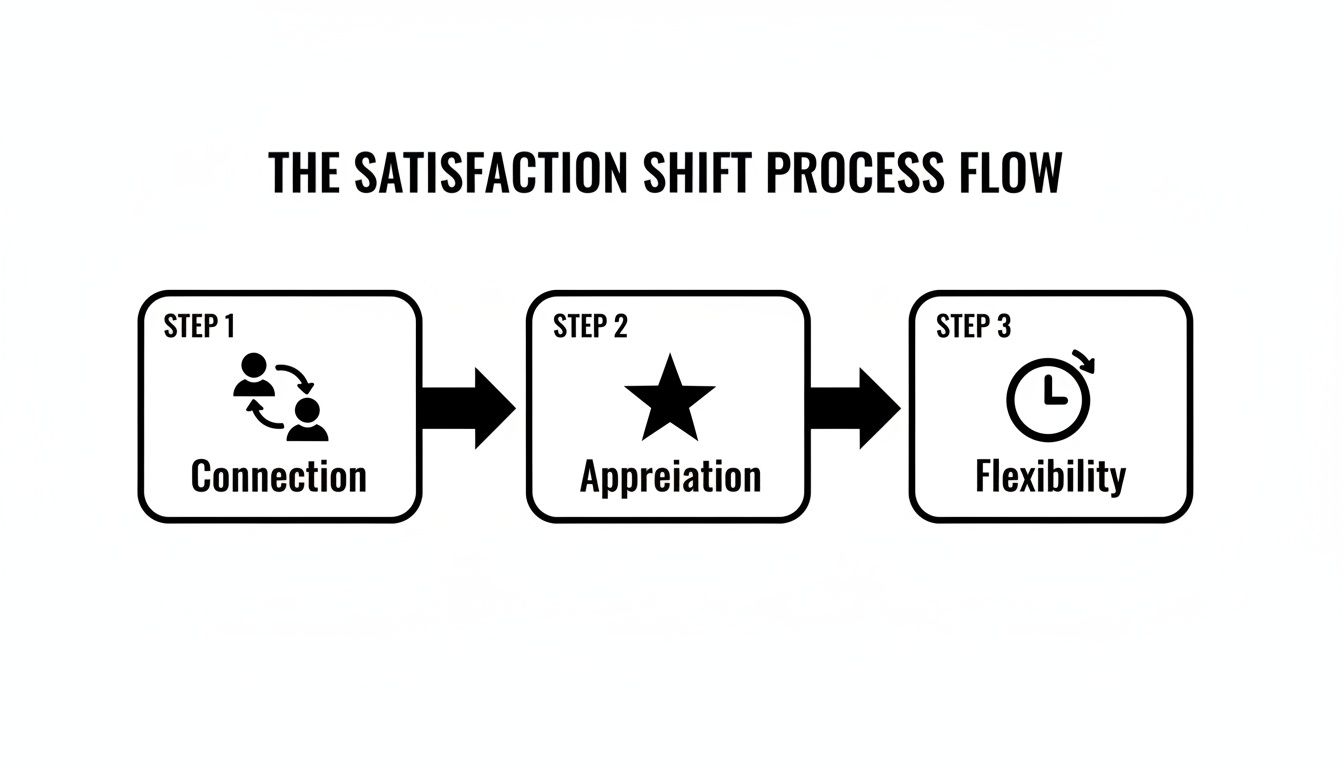
This process highlights that boosting satisfaction isn't a one-off task. It’s a continuous cycle of building human bonds, recognising people's hard work, and offering the autonomy they need to thrive.
To find out what's really going on, you need to ask smart questions. This table breaks down the different methods you can use to get to the heart of employee sentiment.
| Method | Primary Focus Area | Key Question to Ask | Implementation Tip |
|---|---|---|---|
| Anonymous Surveys | Quantitative Morale Check | "On a scale of 1-10, how likely are you to recommend our company as a great place to work?" | Use a simple tool like Google Forms or SurveyMonkey. Keep it short (5-7 questions) and run them quarterly. |
| Stay Interviews | Retention & Motivation | "What's one thing that would make your job better right now?" | Schedule these as informal 30-minute chats, not formal performance reviews. Focus on listening, not problem-solving. |
| Exit Interviews | Root Cause Analysis | "Was there a specific event or turning point that prompted you to start looking for a new role?" | Have a neutral third party (like HR) conduct the interview to encourage more candid feedback. |
| Team Retrospectives | Process & Collaboration | "What should we start doing, stop doing, and continue doing as a team to work better together?" | Make this a regular, blameless meeting at the end of big projects. Focus on process, not people. |
| 1-on-1 Check-ins | Individual Wellbeing | "How are you feeling about your workload and work-life balance this week?" | Make this the first question you ask in every one-on-one. It signals that you care about them as a person. |
By combining these methods, you build a complete picture of your team's experience. You move from making assumptions to knowing exactly where to direct your energy for the biggest impact.
Feeling seen and valued isn't just a nice-to-have at work; it's a fundamental human need that directly fuels employee satisfaction. Too many companies fall into the trap of treating recognition like an annual event—a bonus cheque or a formal review. That completely misses the point.
To genuinely make a difference, recognition needs to be woven into the very fabric of your company culture. It should be frequent, authentic, and come from all directions. We need to move beyond top-down praise and build a system where appreciation flows freely between peers, from managers, and across the entire organisation. When people see their contributions noticed and celebrated in real-time, it’s a powerful validation that their work truly matters.

A real culture of recognition is multi-layered, combining small, immediate gestures with bigger, more formal celebrations. Think of it as creating an ecosystem of appreciation that keeps morale high and strengthens team bonds, especially in today's hybrid and remote work setups.
Here’s what that looks like in practice:
This is exactly where modern tools can step in to make a massive difference. For teams spread across the United Kingdom, the United States, or even India, something as simple as a group online card from Firacard can bridge the physical distance. Imagine celebrating a team member's fifth work anniversary by having everyone contribute messages, photos, and even short videos. It creates a lasting digital keepsake that feels personal and deeply meaningful.
For any recognition to land well, it has to be authentic. It can't feel like a box-ticking exercise. This means tailoring the acknowledgement to the individual and their specific achievement. Public praise is a huge motivator for some, but for others, a thoughtful, private message means the world.
This is especially true for major life events and career milestones. When someone gets married, has a baby, or celebrates a big birthday, acknowledging it shows you care about them as a person, not just as an employee. A collaborative birthday ecard filled with warm wishes from the whole team makes someone feel truly part of the family, no matter where they are. As a practical Kudoboard alternative, these platforms make it simple to organise and deliver heartfelt messages.
A recent study revealed that appreciation is a complete game-changer for UK employee satisfaction. An incredible 92% of UK employees report higher job satisfaction and 88% feel increased loyalty when their contributions are recognised. However, the UK currently lags behind other countries in this area, underscoring the urgent need for companies to prioritise a culture of appreciation.
For managers looking to build stronger team cohesion, exploring different approaches is key. Our guide on implementing peer-to-peer recognition programs provides a deeper dive into creating systems that encourage colleagues to celebrate one another.
Even departures offer a crucial opportunity to reinforce a positive culture. How you handle an employee's exit sends a powerful message to everyone who remains. Rushing someone out the door can leave a sour taste, suggesting that people are disposable.
Instead, a thoughtful offboarding process that includes genuine appreciation can turn a potentially negative event into a positive one. A digital leaving card where colleagues can share fond memories and wish the person well shows deep respect for their contributions. This simple act reinforces that every individual is valued, right up to their last day. Whether it's a heartfelt sorry for leaving card or a celebratory farewell, the goal is to honour their journey and maintain a positive connection.
By embedding recognition into daily workflows and key moments, you create a workplace where people feel seen, valued, and motivated to do their best work. This isn't about grand, expensive gestures; it's about the cumulative impact of small, sincere acts of appreciation.
While flexible working offers some incredible perks, it also brings one major challenge to the surface: isolation. When your team is scattered across different locations—and maybe even time zones—those spontaneous chats by the coffee machine and easy office camaraderie can quickly become a distant memory.
To really move the needle on employee satisfaction in a hybrid setup, leaders have to be much more intentional about building and maintaining those crucial human connections. It's about looking beyond the endless cycle of task-focused meetings. Sure, project updates are essential, but they don't build relationships. The real key is to create dedicated spaces and rituals that nurture a sense of community, ensuring no one ever feels like they're on a forgotten island.
It might sound like a contradiction, but one of the best things you can do is to formalise informal connection. It’s all about deliberately carving out time and space for the casual, non-work conversations that used to happen naturally throughout the day.
This isn't just a "nice-to-have." In the UK, strong bonds with colleagues are a massive driver of happiness at work. According to the Drewberry Employee Benefits and Workplace Satisfaction Survey, a whopping 70% of workers say good relationships are the main reason they feel happy on the job, which has a direct link to their overall satisfaction.
Here are a few practical ways to get those connections firing:
“In a hybrid world, you have to architect the serendipity that once happened organically. Building connection is no longer a passive activity; it’s an active leadership responsibility.”
This proactive mindset is what stops a two-tier culture from developing, ensuring both remote and in-office staff have the same opportunities to build strong working relationships.
When your team is distributed, it’s far too easy for big moments to get lost in the shuffle. Birthdays, work anniversaries, and even welcoming a new team member require a more deliberate effort to make them feel special. This is where modern tools can make all the difference, turning a simple nod of acknowledgement into a shared team experience.
For instance, when a new person joins, passing around a group online card for everyone to sign is a brilliant way to create an instant feeling of welcome and belonging. It’s a small gesture that shows them they're already part of the community. As a leading Kudoboard alternative, platforms like Firacard make it incredibly easy for teams across the United Kingdom, United States, and Canada to all chip in.
In the same way, celebrating a birthday with a personalised ecard filled with messages, photos, and GIFs makes that person feel truly seen and appreciated. It transforms a digital message into a keepsake they'll actually want to look back on.
Strengthening connection isn't just about the social stuff. It’s also about making your formal communications more inclusive and transparent. All-hands meetings and company updates need to be designed so they’re engaging for everyone, no matter where they’re dialling in from.
Try using interactive elements like polls, live Q&As, and breakout rooms to get people involved rather than just passively listening. Always make sure recordings are shared quickly for anyone in a different time zone. When people are kept in the loop about company goals and changes, they feel more connected to the bigger picture and more secure in their role—a cornerstone of how to improve employee satisfaction for the long haul.
After recognition and connection, we need to talk about the third pillar of modern employee satisfaction: flexibility. People today aren't just looking for a nine-to-five; they're searching for a role that actually fits into their life, not the other way around. This means going beyond just offering remote work and embracing genuine autonomy.
When you give your team real control over their schedules, you're doing more than just offering a perk. You're sending a powerful message of trust. This move away from micromanagement directly tackles burnout and gives morale a serious boost. Real flexibility means your team members can do the school run, get to an appointment without feeling guilty, or simply structure their day around when they feel most productive.

Offering genuine flexibility isn't something you can just switch on; it requires a deliberate shift to focusing on outcomes, not just hours logged. And the demand for it is exploding. Flexible working is a massive factor for employee satisfaction in the UK, with a staggering 59% of employees who don't have it planning to leave their jobs within the next year. That's a huge wake-up call for businesses to adapt.
So, what does this look like in practice? Here are a few policies that actually work:
A flexible schedule is a great start, but it's only one piece of the wellbeing puzzle. A truly supportive workplace culture has to champion mental health and actively encourage people to disconnect. Burnout is a real and present danger to satisfaction, and companies need to be proactive about it. A big part of that is understanding the day-to-day challenges people face, like navigating workplace relationships amidst stress, to build a truly supportive culture.
This means providing mental health resources that are actually easy to access, like confidential counselling services or wellness app subscriptions. Even more crucial is seeing leaders model healthy behaviours—taking their full annual leave, not firing off emails at 10 p.m. When the team sees that the leadership respects personal boundaries, it fosters a psychologically safe space where everyone feels they have permission to properly switch off. For more on this, check out our guide on how to redefine success and avoid burnout.
True wellbeing isn't about offering yoga classes to combat a culture of overwork. It's about designing a work environment where those classes are a genuine supplement, not a necessary remedy.
The way a company handles someone's departure says everything about its culture. A thoughtful, respectful offboarding process reinforces a positive environment for the colleagues who stay. It’s your final chance to show you’re committed to your people’s wellbeing.
Instead of a quick, transactional exit, take a moment to properly acknowledge their contributions. Organising a farewell gesture, like a virtual leaving card, lets the whole team share fond memories and wish them well. A heartfelt sorry for leaving card from Firacard can turn a standard goodbye into a supportive and respectful transition. It's a simple act, but it shows you value people beyond the work they produce, cementing a culture of care that stays with your team long after someone has moved on.
Here are some straight answers to the questions we hear most from UK managers and HR leaders. No fluff, just practical advice to help you build a happier, more engaged team.
If you're watching the pennies, the single most powerful thing you can do is build a real culture of recognition. It doesn't have to be about big, expensive gestures. It's the small, frequent, and genuine acknowledgements that really move the needle.
Start simple. Encourage peer-to-peer shoutouts in your team meetings or set up a dedicated Slack channel. For milestones like birthdays or work anniversaries, using a free or low-cost group greeting card platform lets the entire team chip in with heartfelt messages. The emotional payoff is huge for a tiny financial outlay. When you remember that 92% of UK employees feel more satisfied at work when they're appreciated, focusing on recognition offers a massive return.
You need a mix of numbers and stories. To really see if your efforts are making a difference, you need to look at both quantitative and qualitative data. A great starting point is to establish a baseline with an anonymous survey using a simple metric like eNPS (Employee Net Promoter Score).
Once you've rolled out new programmes—like a new recognition scheme or more flexible working hours—run that same survey again every quarter or six months to see how the needle is moving. But don't just rely on the scores. Back up that hard data with qualitative feedback. Sit down with your top performers for 'stay interviews' to hear firsthand what's making them stick around.
Finally, keep an eye on the classic HR metrics: voluntary turnover and absenteeism. If you see your turnover rate dropping while your eNPS score is climbing, that’s a clear sign you’re on the right track.
Let's be blunt: if your managers aren't bought in, your initiatives are doomed to fail. The secret is to make it easy for them and show them how it directly impacts their own success.
First, train them on the undeniable link between their team's happiness and its performance. We're talking productivity, innovation, the lot. But don't stop at theory. Give them simple, practical tools they can use tomorrow, like templates for better one-on-one meetings or easy-to-use platforms for team recognition.
Making it simple for managers to celebrate their team is crucial. If recognising a birthday takes more than a few clicks, it's less likely to happen consistently.
You have to remove the friction. Arm them with tools that make appreciation effortless, like setting up a personalised ecard for team milestones. A platform like Firacard, a popular Kudoboard alternative, lets a manager quickly organise a group online card that everyone can sign in minutes. When doing the right thing is that easy, managers will actually do it.
Ultimately, you need to connect employee satisfaction to their performance reviews. When their team's engagement score becomes a key measure of their success, it suddenly becomes a priority. This aligns their personal goals with the company's, giving them a real incentive to champion their team's wellbeing.
Ready to build a culture where every employee feels seen and valued? With Firacard, you can create and share beautiful group cards for birthdays, farewells, and celebrations in minutes. Start making recognition simple and meaningful today by exploring your options at www.firacard.com.


Stuck in a rut writing the same old birthday message? This year, ditch the clichés and learn how to create genuinely funny rhymes for birthdays th
Saying goodbye to a teacher is a really big deal, and goodbye teacher cards are a fantastic way to show them how much you appreciate everything the
Graduation marks a monumental milestone, a culmination of years of dedication and hard work. But finding the right words to capture your pride and