Creative Goodbye Teacher Cards That Make an Impact
Saying goodbye to a teacher is a really big deal, and goodbye teacher cards are a fantastic way to show them how much you appreciate everything the


Nov 13, 2025 | 24 Min Read
Learning how to thank donors the right way is all about a simple but powerful shift in how you think about it. Don't treat it as just another task to check off your list. Instead, see it as your very first—and best—chance to build a real, lasting relationship.
A prompt, personal, and impact-focused thank-you can turn a one-time transaction into the start of a meaningful partnership, making it far more likely that they’ll give again.
Let's get past the idea that thanking donors is just about being polite. A genuine, well-thought-out thank-you is one of the most effective tools in your fundraising kit. It's not just a courtesy; it's a core function with a measurable return, directly impacting donor loyalty and how much they give in the future.
When you show gratitude well, you make your supporters feel seen, valued, and truly connected to the mission they chose to back.
This simple act of acknowledgment transforms a financial transaction into an emotional connection. It confirms for the donor that their gift landed safely, that it actually matters, and that you're going to put it to good use. Closing that loop builds a foundation of trust that is absolutely essential for long-term support. If you really want to get it right, understanding the psychology of gifting can help you see how reciprocity and connection are the real drivers behind why people give.
Failing to thank donors properly—or at all—comes with a steep price. It's shocking, but studies have shown that not getting a thoughtful thank-you is the number one reason donors stop giving to a charity.
One report found that a staggering 21% of donors were never thanked at all. Many others received cold, generic acknowledgments that did nothing to build a relationship. This is a massive missed opportunity, especially when research shows that 70% of donors would give more if they received the meaningful appreciation they crave. This insightful donor thank you letter analysis breaks down these findings even further.
A thank-you note is so much more than good manners. It's a strategic tool that validates a donor's decision to give, shows your organization is competent, and sets the stage for a long-term, mutually beneficial relationship.
A great appreciation strategy isn't complicated. It’s built on a few core pillars that work together to create a personal and powerful experience for every supporter. By focusing on these elements, you can design a thank-you process that feels both authentic and scalable.
A generic thank-you is a missed opportunity. If you want to build real, lasting relationships with the people who support your work, you have to move beyond the one-size-fits-all email. That’s where segmentation comes in—it’s the simple but game-changing practice of grouping donors based on what you know about them.
By segmenting, you can stop sending robotic acknowledgments and start having conversations. Each thank-you can be tailored to feel relevant, respectful, and genuinely appreciative of a donor's specific relationship with your mission. It's the difference between junk mail and a personal letter.
Think of it like this: every gift is a fork in the road. A thoughtful, personalized response keeps the relationship moving forward. A generic one often leads to a dead end.
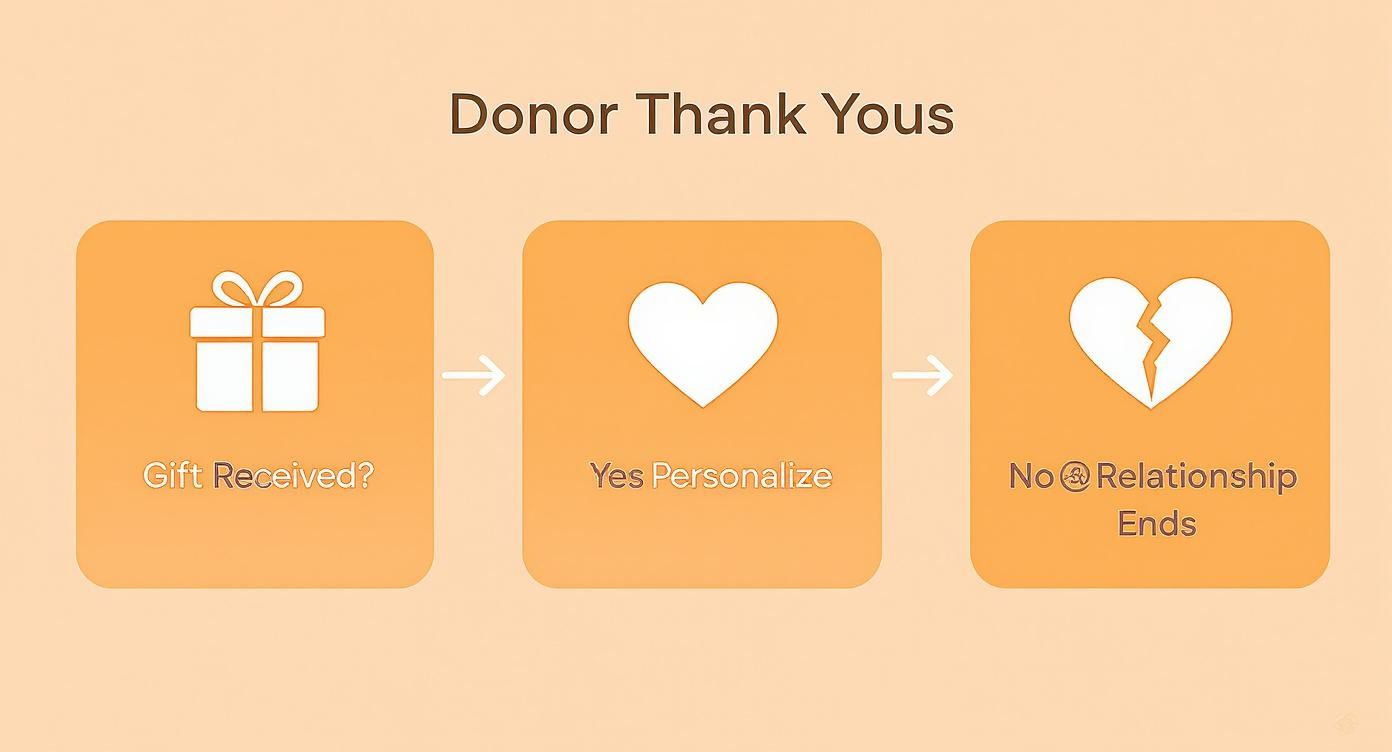
This decision tree nails a core principle of donor relations: personalization is what determines whether a supporter's journey continues long after their first gift.
One of the most straightforward ways to start is by looking at the size of the donation. It just makes sense that the level of effort you put into a thank-you should reflect the level of investment a donor has made. This approach helps you use your resources wisely while making every single supporter feel seen.
A donor's history with you tells a story, and acknowledging that story shows you're paying attention. When donors feel truly appreciated, they are four times more likely to give again. That’s not a small number—it’s a cornerstone of any solid retention strategy.
Recognizing where someone is in their giving journey—whether it's their first donation or their fiftieth—is essential.
Thanking a donor isn't just about acknowledging their past gift; it's about nurturing their future support. How you thank a first-time giver can determine if they ever give a second time.
Here’s how you can respond to the different chapters of a donor’s story:
Finally, think about who the donor is. An individual writing a personal check is often moved by different things than a corporation making a strategic philanthropic gift.
A personal story might resonate deeply with an individual donor, but a corporate partner will likely want to see data on community impact and brand visibility. You have to speak their language. For example, if an entire department at a company rallies to support your cause, a collective thank-you is in order. A tool like a Firacard lets your team gather personal messages, photos, and GIFs—much like you would for farewell cards—and send them as one big, collaborative thank you to the team lead.
To pull this all together, here’s a practical matrix you can adapt for your own organization. It connects the dots between who the donor is and how you can thank them most effectively.
| Donor Segment | Gift Size | Recommended Thank-You Method(s) | Timing Goal | Who Should Thank Them? |
|---|---|---|---|---|
| New, Small-Dollar | < $100 | Personalized email, welcome series, social media shout-out (group) | Within 24 hours | Development Coordinator |
| Recurring, Small-Dollar | < $100 monthly | Quarterly impact summary email, surprise postcard, annual thank-you video | 24 hours (receipt), quarterly (updates) | Development Coordinator |
| New, Mid-Level | $100 – $999 | Personal email from Program Director, follow-up phone call | Within 48 hours | Program Director / Staff |
| Loyal, Mid-Level | $100 – $999 | Handwritten note, personal call from staff, invite to a virtual event | Within 1 week | Development Manager |
| Major Donor | $1,000+ | Personal call from CEO/ED, handwritten note, impact report, exclusive event invite | Within 24 hours (call), 48 hours (note) | CEO / Executive Director |
| Corporate Partner | Varies | Collaborative digital card, impact report, feature in annual report, joint press release | Within 1 week | Corporate Relations Manager |
| Lapsed Donor (Returning) | Any | "Welcome back" personal email, phone call to reconnect | Within 48 hours | Development Director |
This framework isn't rigid—it's a starting point. The goal is to create a system that ensures every donor receives the most meaningful acknowledgment possible, turning a simple transaction into a genuine connection.
How you say thanks matters just as much as what you say. The channel you pick to deliver your gratitude can completely change how it lands. A handwritten note feels intimate and thoughtful in a way a generic email just can't, while a social media shout-out offers public praise that some donors really appreciate.
The trick is to match the channel to the donor and the size of their gift. A smart mix of old-school and modern methods makes your appreciation feel personal and appropriate, deepening that donor’s bond with your mission.
Some thank-you methods have stuck around for a reason: they just work. These high-touch, personal channels are incredibly powerful for building deep, lasting relationships, especially with your mid-level and major donors who’ve made a serious investment in your work.
These classic approaches take more elbow grease, but the payoff in donor loyalty is huge. They show a level of care that no automated system can ever truly match.
Digital tools give you speed, scale, and some really creative ways to express gratitude. They’re perfect for quickly acknowledging gifts from your smaller-dollar donors and can be a great complement to the more traditional methods you use for larger supporters.
One of the biggest wins with digital is the ability to share dynamic content that shows a donor's impact in a real, tangible way.
A great digital thank-you does more than confirm a gift was received; it instantly connects the donor to the positive change they just made possible, closing the loop between their action and your mission's outcome.
Here are a few digital channels that really hit the mark:
Sometimes, a thank-you needs to come from a whole group, not just one person. This is especially true when you're thanking a corporate team for a fundraising drive or a major donor whose gift directly touched the lives of a specific group, like students or program participants.
This is where collaborative digital platforms like Firacard are a game-changer. They let you gather messages, photos, GIFs, and even videos from multiple people onto a single, beautifully designed digital card.
For example, you could create a board where scholarship recipients each add a personal note of thanks to the donor who funded their education. The final card becomes this powerful, collective wave of gratitude that shows the real-world impact of their gift in a deeply personal way. You can dig deeper into this approach in our guide on expressing gratitude with online thank you cards from Firacard.
This screenshot shows just how simple it is to set up a collective card, which is a similar process to their popular farewell cards.

The interface is super intuitive, making it easy to pull together contributions from lots of people. It turns a simple thank-you into a memorable and shareable experience that your donor won't soon forget.
In a world drowning in digital noise, a personal phone call cuts through like nothing else. It can forge a powerful, immediate connection that an email or text simply can't match.
Still, plenty of organizations get a little phone-shy. They worry it’ll be awkward, clunky, or just too time-consuming. But when you get it right, a quick call is one of the most effective stewardship tools in your entire playbook, turning a simple acknowledgment into a genuinely memorable conversation.
The secret? Remember the call has one—and only one—purpose: to express pure, unadulterated gratitude. This isn't a sales pitch or a cleverly disguised ask. It's a moment dedicated entirely to making your donor feel seen, valued, and appreciated for their generosity.
Think about it. A phone call shows you took time out of your day, specifically for them. It signals a level of personal effort that a standard email template just can’t replicate, reinforcing how important that supporter is to your mission.
That said, the topic isn't without debate. A widely cited 2019 study on public TV station donors found that thank-you calls didn't really move the needle on retention. Giving rates were identical at 28% for both the group that received a call and the one that didn't. You can discover more about these findings to dig into the nuances yourself.
So, what's the real takeaway here? A generic, check-the-box call probably won't work. But a warm, genuine, and well-timed call absolutely can. It's all about the quality of the interaction.
Having a simple script can give your staff and volunteers the confidence they need to make calls that feel natural, not robotic. The goal isn't to read it word-for-word, but to have a flexible guide to lean on.
Scenario 1: Calling a First-Time Donor
Scenario 2: Calling a Long-Time Supporter
You won't always reach someone on the first try, but a great voicemail is another chance to make a fantastic impression. The key is to keep it brief, warm, and crystal clear.
"Hi [Donor Name], this is [Your Name] calling from [Organization]. I was just calling to say a huge thank you for your recent donation. Your support is making a real difference, and we are so grateful. That's it! No need to call back—we just wanted to share our appreciation. Thank you again!"
This approach is perfect. It delivers the gratitude, respects their time, and leaves the donor feeling good without creating an obligation to respond. It’s a win-win.
To really scale your efforts, you need to empower everyone—from staff to board members to volunteers—to pick up the phone. Here's how to set them up for success.
Whether it arrives in an inbox or a mailbox, a well-written thank-you note is still one of the most powerful tools in your donor stewardship toolbox. It does more than just confirm a gift; it deepens the emotional bond a donor feels with your mission and reassures them that they made a great decision.
The secret to writing a message that donors actually read and remember is getting beyond generic, transactional language. You have to be prompt, personal, and profoundly impactful.

Before you even think about writing, there are a few core principles that should be second nature. These pillars make sure every message you send feels genuine, strengthens the relationship, and truly honors your supporters' generosity. Great thank-yous aren't just polite—they're a strategic part of keeping donors around for the long haul.
For online gifts and smaller donations, email is your go-to for a quick thank-you. But "fast" should never mean "impersonal." A great thank-you email feels warm, sincere, and human. If you want to dive deeper, there are some great tips on How to Write a Thank You Email That Gets Read.
The best thank-you messages make the donor the hero of the story. Shift the focus from "look what we're doing" to "look what you made possible."
Here’s a simple but effective example for a recurring donor.
Email Example for a Recurring Donor
Subject: You're Making a Difference, [Donor Name]!
Hi [Donor Name],
I just wanted to reach out personally and say thank you for your latest monthly gift of [Amount]. Your consistent support is the bedrock of our work, allowing us to plan ahead and be there when we're needed most.
Because of you, a family in our shelter has a safe, warm place to sleep tonight. It’s steady generosity like yours that makes these moments of comfort and security possible.
We are so incredibly grateful to have you with us.
Warmly,
[Your Name]
[Your Title]
This works because it’s personal, connects the gift to a specific outcome, and feels like it came from a real person.
A classic mistake is mushing the sterile, formal tax receipt together with a heartfelt thank-you. The legal jargon required for tax purposes can completely kill the warm, fuzzy vibe you're going for. The best approach is to keep them separate.
This two-touch approach ensures you meet your legal obligations without sacrificing the personal connection that builds real donor loyalty.
For special occasions, like thanking a corporate team for their fundraising efforts or a major donor who funded a new project, you can go beyond a simple letter.
Tools like Firacard let you create a shared digital space where your whole team can express their thanks. You can gather notes, photos, and even short video messages from staff, volunteers, or the people who benefited from the gift. It's a lot like creating collaborative farewell cards, turning a simple thank-you into a powerful, shared experience that brings the donor's impact to life.
An effective thank-you strategy isn't just a list of tasks to check off—it’s something that gets woven into the very fabric of your organization. As your nonprofit grows, the goal is to build systems that make gratitude a consistent, sustainable practice, not an afterthought that falls by the wayside when things get hectic.
This means looking beyond the development team. A real culture of gratitude involves everyone, from board members and program staff to the volunteers who greet people at the front desk. When your entire team feels empowered and equipped to say thanks, donors feel the warmth and authenticity coming from your whole organization.
To pull this off, you need a clear game plan. Gratitude needs to be tracked, measured, and celebrated internally, just like any other key metric you care about.
You can't improve what you don't measure. The first step is simply tracking your acknowledgment efforts in your CRM. This ensures no donor ever falls through the cracks and allows you to see who was thanked, when, and how, preventing awkward duplicate messages or missed opportunities.
But simple tracking isn't enough. You need to connect your stewardship activities directly to your fundraising success. That's where the real magic happens.
A sustainable gratitude strategy is systematic. It relies on clear processes and shared responsibility to ensure every donor feels valued, every time, regardless of how busy your team gets.
Creating a true culture of gratitude means making it everyone's job. This organization-wide approach not only lightens the load on your development staff but also makes the expressions of thanks more diverse and authentic. Beyond individual thank yous, this involves a continuous effort in building strong bonds with your backers.
Actionable Tips for a Gratitude Culture:
Ultimately, making gratitude a systematic practice is about embedding it into your daily operations. For more ideas on fostering this mindset, check out our guide on how to improve workplace culture.
Getting the little details right can make a huge difference in your donor relationships. Let's walk through a few of the most common questions that pop up when building a solid donor thank-you process.
Aim for 24-48 hours. Speed is everything here.
A prompt, personal thank-you that lands while the donor's generosity is still fresh in their mind reinforces their good feelings. It also shows your organization is on the ball, responsive, and genuinely appreciative. Don't let that initial warmth fade.
Hard no. A thank-you note has one job and one job only: to express sincere gratitude.
Tucking another fundraising appeal inside makes the whole thing feel transactional and hollow. It can seriously damage the trust you're trying to build. Save your next ask for a completely separate communication down the road.
Your recurring donors are your champions, and they deserve ongoing, special appreciation that goes beyond the automated monthly receipts.
Think bigger. You could send an annual impact summary showing their total contribution for the year, make a surprise thank-you call out of the blue, or invite them to an exclusive virtual briefing with your leadership. The key is to constantly remind them of the sustained, incredible difference they're making.
Ready to create a thank-you experience your donors will never forget? With Firacard, you can easily gather messages, photos, and videos from your entire team or community onto one beautiful, collaborative digital card. It's the perfect way to show collective gratitude and bring your mission's impact to life.
Explore our group cards at www.firacard.com, including our popular farewell cards format that works great for celebrating volunteers and team members, too.


Saying goodbye to a teacher is a really big deal, and goodbye teacher cards are a fantastic way to show them how much you appreciate everything the
Graduation marks a monumental milestone, a culmination of years of dedication and hard work. But finding the right words to capture your pride and
Let's be honest, trying to find the perfect present from a UK gift shop online can feel like wading through a sea of options. It’s not just