8 Unforgettable Styles of Funny Rhymes for Birthdays (2026 Edition)
Stuck in a rut writing the same old birthday message? This year, ditch the clichés and learn how to create genuinely funny rhymes for birthdays th


Jan 3, 2026 | 18 Min Read
When your team is split between the office and home, a natural disconnect starts to creep in.This is the root of almost every hybrid workplace challenge. It’s not just about logistics; it’s about maintaining a cohesive, fair, and productive culture when people are physically apart. Getting this right means being incredibly intentional about bridging the gaps between the physical and digital workspace.
Welcome to the new world of work, where we're all trying to strike a balance between flexibility and connection. Shifting to a hybrid model wasn't just about changing where we work—it has completely reshaped the employee experience.
Think of it like trying to conduct a symphony orchestra where the musicians are all in different cities. To make beautiful music, you need flawless tech (the instruments), clear leadership (the conductor), and a shared sense of rhythm (the culture). Without all three, you just get noise.
This new arrangement definitely introduces some friction. As companies try to figure out what works, the policies are constantly changing. In the UK, for instance, we're seeing a major shift back towards mandated office days. Recent data shows a staggering 85% of UK job postings for hybrid roles now demand at least two days a week in the office. That's a huge jump from 2023, when only 43% had that requirement.
This visual breaks down the three pillars of hybrid work challenges that leaders need to get their heads around.

As you can see, the core issues of communication, culture, and inclusion are all interlinked. When one area suffers, it pulls the others down, directly hitting productivity and your ability to keep good people.
To really tackle these challenges, you have to understand where the friction comes from. Of course, the technical stuff has to be solid—you can’t have a great hybrid culture without the best internet for remote work.
But beyond the tech, it’s the human element that matters most. For more on this, you can check out our guide on powering productivity in a remote work world. The main pain points we see time and again are:
One of the sneakiest challenges of hybrid work is stopping a two-tiered culture from creeping in. It happens slowly, almost invisibly, creating an ‘in-office’ crew and a ‘remote’ team who experience work in completely different ways. Before you know it, that sense of unity you worked so hard to build starts to fracture.
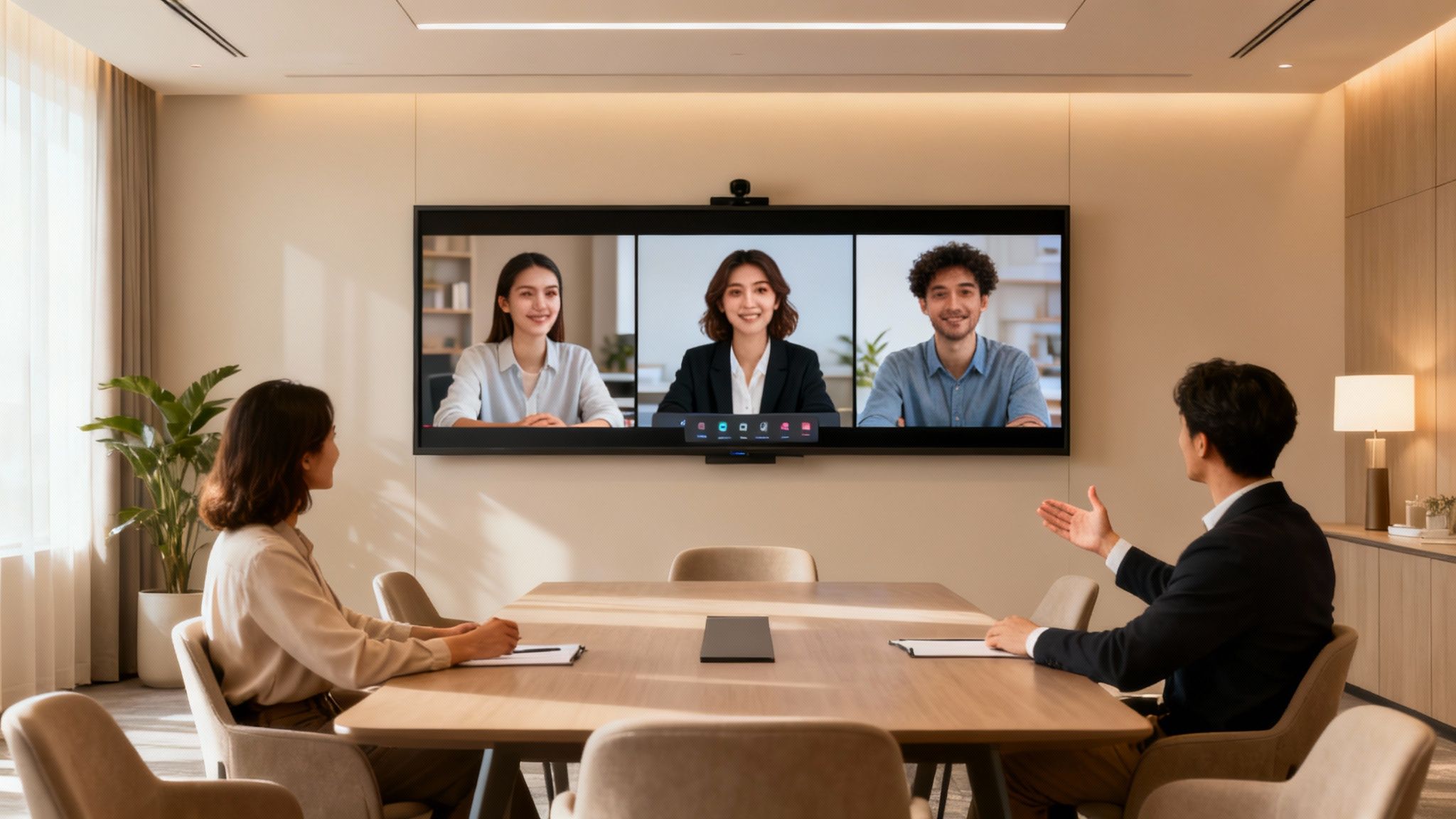
This split usually starts with proximity bias—our natural, unconscious tendency to favour the people we physically see every day. A manager might give more spontaneous feedback, hand out more interesting projects, or offer more mentoring to the person at the next desk. Over time, this creates an uneven playing field where opportunity is dictated by visibility, not talent.
It doesn't take long for remote employees to feel like second-class citizens. That feeling leads to disengagement, a breakdown in trust, and eventually, people heading for the door. And rebuilding that trust is a much steeper climb than preventing the divide in the first place.
The fairness issue goes even deeper than day-to-day interactions; it starts with who even gets the option to work hybridly. In the UK, there's a huge disparity. A whopping 42% of workers with degree-equivalent qualifications have a hybrid arrangement. Compare that to just 4% of those with no qualifications.
This gap shows how hybrid work is often concentrated in sectors like IT and professional services, creating a sense of resentment and undermining any efforts to build a truly inclusive culture. You can discover more insights on UK hybrid working access from the ONS.
To fight this, leaders have to be deliberate. It means completely rethinking how we measure people's contributions and build connections across the whole company. If you're looking to go deeper, we've got a whole post on how to improve workplace culture no matter the setup.
Creating a single, unified culture where location is an afterthought takes real, intentional effort. This isn't about dragging everyone back into the office; it's about engineering an equitable experience for everyone, everywhere.
A truly inclusive hybrid culture is one where career progression, recognition, and a sense of belonging are equally accessible to every employee, regardless of whether they are at a desk in the headquarters or a home office hundreds of miles away.
Here are a few practical ways to make that happen:
We’ve all heard the complaints about ‘Zoom fatigue’, but beneath that surface-level grumble is a much deeper, more corrosive problem: a genuine communication breakdown. When some of your team is physically together and the rest are dialling in, those natural, spontaneous moments that build real camaraderie and spark brilliant ideas start to evaporate.
Think about it. Those informal 'water cooler' chats or quick desk-side questions that can solve a problem in minutes? They’re gone. In their place, we have a calendar full of scheduled meetings and a constant stream of formal digital messages that often feel slow and impersonal. Over time, a subtle communication divide emerges, impacting everything from project deadlines to team morale.

This gap gets even wider because it’s so much harder to read non-verbal cues on a screen. A slight hesitation or a thoughtful pause, which you'd easily understand in person, can be misinterpreted as disagreement or disinterest on a video call. These tiny misunderstandings stack up, creating friction and leaving remote team members feeling out of the loop and less connected.
To stop these communication silos from taking hold, leaders have to get incredibly intentional about creating channels and routines that pull everyone together. This isn't just about buying the right software; it's about building a communication culture that is inclusive by design.
A brilliant first step is to establish a clear communication charter. This is basically a rulebook that outlines which tools to use for which conversations, setting clear expectations for the whole team.
To make this even clearer, think about your communication toolkit like this:
| Scenario | Recommended Tool or Method | Why It Works Best |
|---|---|---|
| Urgent issue blocking a task | Direct message (Slack/Teams) | Gets a fast response without interrupting everyone. |
| Weekly team progress sync | Scheduled video conference | Ensures everyone has face-time and feels included. |
| Brainstorming a new campaign | Collaborative whiteboard (e.g., Miro) + video | Allows for visual, free-flowing ideas from all locations. |
| Sharing a major company win | All-hands email + celebratory chat channel | Creates a formal record and a space for informal reactions. |
| Celebrating a colleague's birthday | Group eCard (like Firacard) | Asynchronous, inclusive, and adds a personal touch. |
This isn't about rigid rules, but about providing a framework so everyone knows the best way to connect, no matter the situation.
The goal is to make communication so seamless and consistent that physical location becomes irrelevant. An employee working from home in Australia should feel just as informed and connected as someone in the London office.
A huge part of keeping connections strong is recreating the social rituals that happen so naturally in an office. This is where simple, thoughtful tools can make all the difference. Think about celebrating a team member's work anniversary or a successful project launch.
Instead of a generic email, a group online card lets everyone—no matter their time zone—share a personal message, a funny GIF, or a photo. Sending a vibrant birthday ecard that the whole team has signed can make a remote employee feel genuinely seen and appreciated.
When a beloved colleague moves on, a virtual leaving card becomes a powerful digital keepsake, capturing memories and well wishes from the entire team. These small, intentional acts of connection are the secret weapons in combating isolation and reinforcing that everyone is a valued part of the same crew. If you need more inspiration, check out our guide to engaging hybrid team-building activities to keep your team’s spirit high.
When the commute from the bedroom to the home office is just a few steps, the lines between professional and personal life get incredibly blurry. Suddenly, the work day doesn't really have an end. This is where we see a nasty culture of 'digital presenteeism' creep in—that unspoken pressure to be constantly online and available, paving a direct path to burnout.

This setup creates a double-edged sword for wellbeing. For fully remote folks, the isolation can take a serious mental toll. For those splitting their time, there's the added logistical stress of managing two different workspaces. The only way forward is to stop treating employee wellbeing like a fluffy perk and start seeing it for what it is: a core performance indicator for the whole organisation.
Finding the sweet spot is tricky, though. A 2023 survey from the UK Hybrid Work Commission showed just how divided employers are on productivity: 33% felt it was a boost, 36% saw no real change, and 13% noticed a dip. At the same time, 47% of workers said the flexibility massively improved their wellbeing. It’s clear companies are walking a tightrope, trying to keep people happy and healthy without letting business goals slip.
To get ahead of this, HR leaders need to shift from simply reacting to problems to proactively preventing them. It’s about building a framework that actively protects your team's time, energy, and mental health. A great place to start? Setting some crystal-clear boundaries.
An environment that prioritises wellbeing is one where logging off is not just permitted but actively encouraged. The 'right to disconnect' should be a cultural norm, not a policy buried in a handbook.
Here are a few actionable ideas to help you build that supportive space:
At the end of the day, building a resilient and healthy hybrid team boils down to trust and psychological safety. It’s about creating a culture where it's okay to not be okay. For anyone who personally struggles to switch off, it's also worth understanding the deeper drivers of overwork. If that rings a bell, our guide on breaking free from toxic productivity and avoiding burnout might be just what you need.
How can you fairly measure someone's performance when you don't physically see them every day? This is a massive question for hybrid teams and it's forcing us to completely rethink what it means to be 'productive'. For years, many managers relied on visibility. They rewarded ‘presenteeism’—the act of simply being seen at a desk, looking busy. In a hybrid world, that approach isn't just outdated; it's actively harmful.
When we cling to old habits, we create a two-tiered system. In-office employees can appear more productive just because they're physically present, while their remote colleagues, who might be delivering incredible work, are overlooked. That’s a fast track to resentment and disengagement.
The only way forward is to build a clear, transparent framework that judges performance purely on results. It’s about focusing on tangible contributions, not on who is quickest to turn their light on in the morning.
Beyond day-to-day work, one of the biggest anxieties for remote and hybrid employees is career growth. They worry that without the spontaneous coffee chats or hallway conversations with senior leaders, their professional development will grind to a halt.
It's a valid concern. If your mentorship programmes or key training sessions are mainly held in the office, remote staff are instantly left out. If promotions are influenced by who you know from bumping into them in the canteen, you're building an invisible barrier for your distributed workforce.
The core principle is simple: opportunity should never be tied to geography. A team member's career trajectory must be determined by their skills, ambition, and impact—not by their proximity to the executive suite.
To make this a reality, you have to be intentional. It's about designing structured programmes that everyone can access, no matter where they dial in from.
These kinds of structured approaches help to dismantle proximity bias, making sure that career development is a fair game for every single employee. And when people do hit those milestones, it's crucial to celebrate them properly. When someone lands a promotion, sharing a group online card or a personalized ecard lets the entire team, whether they're in the office or across the country, join in on the success.
Policies and tech are important, but they’re just pieces of the hybrid puzzle. If you really want to build a thriving distributed team, the secret lies in being deliberate about your culture. Small, consistent acts of recognition are the glue that holds it all together.
When your team is scattered, you have to work a little harder to create those shared experiences that used to happen naturally in the office. These moments remind everyone that, whether they’re at HQ or working from their kitchen table, they’re all valued members of the same team. This is where simple, thoughtful tools can make all the difference.
Don't let big wins or milestones get lost in a quick email. Make them memorable. This is where tools like Firacard, a great kudoboard alternative and groupgreeting alternative, really shine, letting you go beyond a simple sorry for leaving card to properly celebrate project wins, work anniversaries, or team achievements with a collaborative group greeting card.
Just imagine a teammate in the UK or Australia waking up to an ecard birthday message packed with notes and GIFs from colleagues across Canada and India. That small gesture instantly transforms a routine celebration into a genuine moment of connection. For more ideas on this, check out our guide on employee recognition best practices.
By embedding these moments of genuine appreciation directly into your team's workflow, you turn potential cultural divides into opportunities for connection. It’s about proving that your culture exists beyond the office walls.
At the end of the day, solving hybrid workplace challenges isn’t about finding one perfect policy. It’s about committing to a culture of intentionality—where communication is clear, development is equitable, and recognition is frequent and heartfelt.
By making things like an online leaving card or a digital leaving card for team celebrations a standard part of how you operate, you’re actively weaving the social fabric that keeps teams tight-knit and resilient. These are the consistent, human touches that turn the challenges of hybrid work into a powerful competitive advantage, creating a workplace where everyone feels they truly belong.
As leaders, we hear the same questions pop up time and time again when navigating the tricky waters of hybrid work. Getting ahead of these common concerns is the first step toward building a model that’s both strong and fair for everyone.
You need to look at both the numbers and the people. On one hand, keep an eye on hard data like employee engagement scores and retention rates. It’s crucial to see if there’s a gap opening up between your remote and in-office teams. But data alone doesn't tell the whole story.
The other half of the equation is genuine human feedback. Regular, anonymous surveys are your best friend here. Don’t just ask generic questions; get specific about their feelings of inclusion, their work-life balance, and whether the communication tools are actually helping them connect.
Hands down, it's treating hybrid work as a logistics problem instead of what it really is: a massive cultural shift. It's a classic pitfall. Companies roll out the right tech, give everyone a laptop, and then… nothing else changes. They forget to adapt how they manage, how they socialise, or how they communicate day-to-day.
This mistake quickly breeds a two-tiered culture, leaving remote employees feeling like second-class citizens. A hybrid model that thrives is one that has been intentionally redesigned from the ground up, rethinking how teams truly connect, collaborate, and celebrate wins together. Sometimes, something as simple as a group greeting card can make a surprising difference.
To make sure things stay equitable, you have to rip physical presence out of the equation. Performance management needs to be about one thing and one thing only: results.
Start by standardising your promotion criteria across the board and making it completely transparent. Next, roll out structured mentorship programmes that anyone can access, no matter where they log in from. Most importantly, you have to actively train your managers to recognise and fight their own proximity bias during reviews. This ensures people are championed for their contributions, not their location, creating a level playing field for team members in the United Kingdom, United States, and beyond.
Ready to strengthen your team's connection, no matter where they work? Firacard makes it easy to celebrate every milestone with a shared online leaving card, group birthday message, or team appreciation board.


Stuck in a rut writing the same old birthday message? This year, ditch the clichés and learn how to create genuinely funny rhymes for birthdays th
Saying goodbye to a teacher is a really big deal, and goodbye teacher cards are a fantastic way to show them how much you appreciate everything the
Graduation marks a monumental milestone, a culmination of years of dedication and hard work. But finding the right words to capture your pride and