50th Birthday Wishes: 8 Meaningful Templates
Finding the right words for a 50th birthday can feel oddly difficult. You want to honour a major milestone without making the message sound like a


Feb 12, 2026 | 21 Min Read
If you want to boost team engagement, forget the occasional pizza party. The real magic lies in a simple, consistent formula: create clear communication channels, foster consistent recognition, and build a shared vision. This isn't about grand, one-off gestures; it's about building a solid foundation of trust and purpose that makes people genuinely feel part of something bigger.
Let's be blunt: a disengaged team isn't just a morale problem. It's a massive drain on your bottom line and the wider economy. These aren't abstract figures; they have tangible, eye-watering consequences.
Take the UK, for example. With only about 10% of workers feeling truly engaged, the national economy is losing an estimated £257 billion every single year. But here’s the flip side—and it’s a big one. Organisations that get this right see incredible results. According to insights from Engage for Success, highly engaged teams are 14% more productive, drive 18% higher sales, and are a whopping 23% more profitable.
The numbers don't lie. Ignoring engagement is like intentionally leaving money on the table. The way forward isn't complicated. It’s about shifting from big, infrequent events to small, consistent actions that build real momentum.
Getting the fundamentals right is everything. A truly engaged team is built on a few core pillars that, when done right, create an environment where people genuinely want to show up and do their best work.
Understanding the broader landscape of employee engagement is the first step toward fixing what's broken. When someone feels checked out, it's almost always because one of these pillars is wobbly. Spotting that is half the battle. If you want to dig deeper, you can learn more about the specific reasons employees feel disconnected in our guide on why employees leave.
One of the biggest mistakes I see is companies treating engagement as purely an HR problem. It’s not. It’s a leadership responsibility, plain and simple. Lasting change only happens when every single manager is equipped—and expected—to build a positive, supportive culture within their own team.
Before you can fix a dip in team engagement, you need to figure out what's actually going on. Guessing or just going with a gut feeling is a recipe for disaster. You might end up trying to solve problems that don’t even exist while the real issues continue to simmer away under the surface. Think of it as a health check for your team culture—it gives you the real data you need to make smart, targeted changes.
You need a clear picture of how everyone’s feeling, whether they’re in the office full-time, fully remote, or bouncing between the two. This means ditching the once-a-year, often-dreaded engagement survey. While those big surveys have their place, a single snapshot can easily miss the day-to-day fluctuations in morale and motivation that tell the real story.
The best way to keep a finger on your team's pulse is, well, with pulse surveys. These are just short, frequent check-ins—maybe a few questions sent out weekly or fortnightly.
They’re designed to capture how people are feeling right now, not how they felt six months ago. A good pulse survey might ask simple things like:
The goal isn't just to gather numbers, but to spot trends. A slow dip in scores over a month could point to burnout, while consistently low scores around resources might reveal a process bottleneck you never knew existed. For managers of distributed teams, these insights are gold. If you're looking to sharpen these skills, check out our guide on how to manage remote teams effectively.
Surveys give you the numbers, but one-on-one meetings give you the stories behind them. For these chats to work, however, they have to be built on psychological safety. Your team members need to know they can be completely honest without any fear of it coming back to bite them.
Frame these meetings as development conversations, not performance reviews. Ask open-ended questions that encourage real reflection:
These regular, structured check-ins are your secret weapon for uncovering the subtle, human reasons for disengagement—things like friction between colleagues or someone feeling undervalued, which a survey is never going to pick up.
This whole process is a continuous cycle. It's about communicating, recognising effort, and sharing a clear vision, all reinforcing each other.
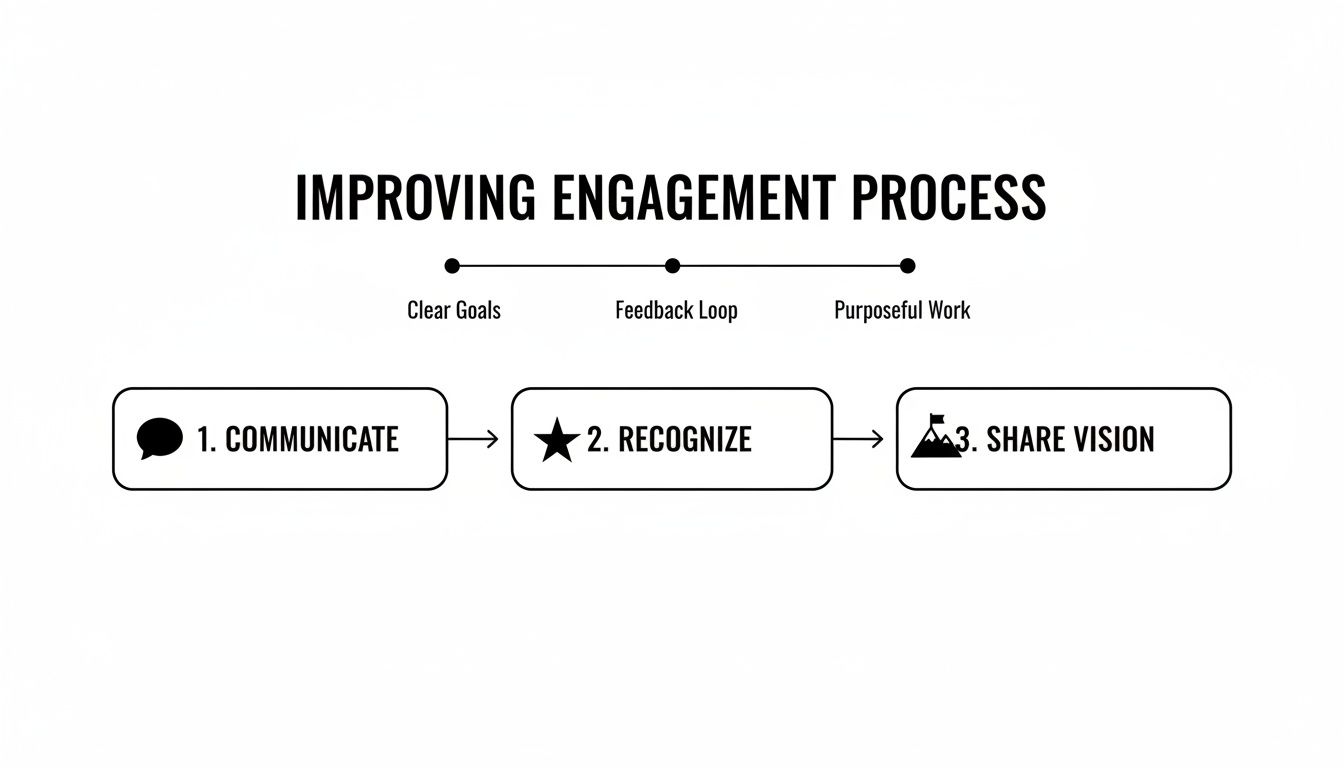
As the visual shows, these aren't just one-off actions. They form a loop that, when done right, builds and sustains a genuinely engaging team culture.
Sometimes, what your team doesn't say is more telling than what they do. Behavioural cues offer another layer of insight, and they're especially important in remote or hybrid teams where you can't just read the room.
Keep an eye out for changes in digital behaviour. Has someone suddenly gone quiet in the team chat? That could signal they’re feeling withdrawn. If a normally collaborative team member stops adding ideas to shared documents or brainstorming sessions, that could be a red flag for disengagement.
Don’t jump to conclusions, though. A missed deadline might look like burnout, but it could just as easily be a personal emergency or unclear instructions. The trick is to use these behavioural hints as a prompt to start a conversation, not as proof of a problem.
By blending quick pulse surveys, candid one-on-ones, and a bit of careful observation, you move from guesswork to genuine understanding. This toolkit gives you a rich, multi-layered view of your team's engagement, turning raw data into a precise plan. With a clear diagnosis in hand, you can finally focus your energy where it will actually make a difference.
Once you've diagnosed where engagement is flagging, your next move should be to lean into one of the most powerful drivers of morale I've ever seen: recognition. Real, genuine appreciation is the fuel that high-performing teams run on. When people feel seen and valued for what they bring to the table, their connection to the company and their colleagues deepens in a way that free lunches never quite manage.
But here's the thing: a culture of recognition isn't built on a once-a-year awards ceremony or a tired "employee of the month" programme. It thrives on the small, consistent, and authentic gestures that happen day in and day out. It’s about creating an environment where acknowledging great work becomes a natural reflex for everyone, not just a task on a manager's to-do list.

While a "well done" from the boss is always welcome, praise from your peers just hits different. It comes from the people in the trenches with you, the ones who truly get the blood, sweat, and tears that went into a project. Empowering your team to celebrate each other is an absolute game-changer for building camaraderie and trust.
A peer recognition programme doesn't need a huge budget or complicated software. You can start simply:
The key is to make it easy and visible. When positive feedback flows freely between colleagues, it chips away at silos and reinforces a culture of mutual support. This simple shift helps everyone feel their daily efforts are noticed, directly tackling that all-too-common feeling of being invisible.
Big project launches are great, but don't forget to celebrate the small victories that pave the way. Acknowledging the mini-milestones—like squashing a tricky bug, landing a small new client, or expertly handling a difficult conversation—keeps momentum high. It shows that you value progress, not just the finish line.
Just as important are the personal milestones. Remembering someone's birthday or work anniversary shows you care about them as a person, not just a name on an org chart. This is especially crucial for remote and hybrid teams where those personal connections can feel a bit more fragile. Imagine a remote employee waking up to a vibrant birthday ecard packed with messages, photos, and GIFs from the whole team. It’s a small gesture that makes them feel genuinely included.
I see so many companies make the mistake of thinking recognition has to be tied to a bonus. While financial rewards have their place, countless studies show that timely, specific, and public praise can be just as—if not more—motivating. The goal is to make people feel valued, and that often has very little to do with money.
Simple tools can make these moments feel special without adding a ton of admin. When a colleague moves on to a new role, for instance, a virtual leaving card lets everyone share memories and well wishes together. It’s not just a sorry for leaving card; it’s a celebration of their time with you. For more ideas, check out our guide on how to show employee appreciation.
The real challenge for global businesses—especially those with teams spread across the United Kingdom, United States, Australia, Canada, India, and Africa—is keeping recognition consistent. This is where digital tools become your best friend. An online leaving card or a shared ecard ensures no one is left out, no matter their time zone.
Platforms like Firacard, a great Kudoboard alternative, make it incredibly simple to create a group online card. Instead of passing a physical card around an office (which is impossible for remote teams), a single link lets everyone add their personal message. It’s a simple but brilliant way to make sure every team member can be part of collective celebrations.
For larger organisations, trying to manage this person by person can quickly become overwhelming. That's when you need to think about scale. Solutions that help you Strengthen Team Bonds with Personalized Bulk Greeting Cards are a lifesaver for HR teams and managers.
The "Bulk Group eCards: Buy More, Save More!" model is particularly useful for businesses. It allows companies to pre-purchase credits for multiple cards at a discount, taking the administrative headache out of every single celebration. It’s a smart investment in your company culture that pays you back in loyalty and engagement. Whether it's a personalized ecard or a custom groupgreeting alternative for a team win, these tools make meaningful recognition a seamless part of how you work.
When your team is small, celebrating wins feels easy and natural. But as you scale up? That personal touch can quickly become a logistical headache. For any HR or People Ops team, the challenge is real: how do you make hundreds, or even thousands, of employees feel genuinely seen without drowning in admin?
This is where you have to start thinking systematically about appreciation. Trying to manage individual celebrations ad-hoc across a whole company just doesn't work. It’s a recipe for inconsistency, where some teams get all the love while others are forgotten. That creates a sense of unfairness that can really poison morale.
The trick is to find a way to scale recognition that keeps that personal feel but simplifies the process. You need a system that empowers managers to celebrate key moments for everyone, efficiently and consistently.
Putting a proper recognition programme in place isn't just a "nice-to-have"—it's a smart business move. When employees feel their hard work is noticed, their loyalty and connection to the company skyrocket. It's a massive driver of both retention and productivity.
But the time cost for HR to manage this manually is huge. Think about it: tracking dozens of work anniversaries, birthdays, and project wrap-ups every month means juggling dates, sending reminders, and chasing managers for their input. That’s valuable time that could be spent on bigger, more strategic work. It’s exactly why more companies are choosing to Strengthen Team Bonds with Personalized Bulk Greeting Cards. Celebrate achievements, milestones, and more. Perfect for businesses, organizations, and individuals..
By adopting a bulk system, you make appreciation an easy, repeatable part of your culture, not an occasional, stressful task.
Platforms that offer bulk purchasing, like Firacard's "Bulk Group eCards: Buy More, Save More!" model, are built to solve this exact problem. Instead of buying a group online card one at a time, companies can purchase credits in advance, usually at a discounted rate. This approach is particularly good for businesses looking to streamline their employee recognition efforts.
This approach has some major perks for bigger organisations:
Picture this: a manager gets an automatic reminder about an upcoming work anniversary. With a bulk system, they can instantly create a beautiful ecard, ping the link to the team to add their messages, and have it land in the person's inbox on the right day. The whole thing takes minutes. It turns recognition from a chore into a simple, meaningful action.
This streamlined approach is a lifesaver for companies with a global footprint, especially those with teams scattered across the United Kingdom, United States, Australia, Canada, India, and Africa. Physical cards are a non-starter, and time zone chaos makes live celebrations nearly impossible.
A digital leaving card or a collaborative ecard birthday ensures that every single team member can get involved, no matter where they are. They can add their message whenever it suits them, creating a rich collection of well-wishes that arrives at the perfect moment.
The real power of a scaled recognition system is that it democratises appreciation. It takes the responsibility off a single department and embeds it into the fabric of every team, making every manager a culture-builder.
When you systematise these moments, you're doing more than just sending a card. You're reinforcing your company’s values and showing every employee that their journey is seen and celebrated. If you want to dive deeper, our guide on the benefits of personalised ecards by Firacard offers even more insights. This consistent, fair approach is a cornerstone of improving team engagement at scale.
Improving team engagement isn't a project with a neat finish line. It's a continuous cycle of listening, adapting, and fine-tuning your approach based on what your people are really experiencing. To keep the momentum going and figure out what’s actually working, you have to move beyond gut feelings and start tracking the real impact of your efforts.
This isn't just about reporting numbers up the chain. When you track key metrics and share the results, you show your team that their feedback leads to genuine change. It’s a powerful way to build trust and prove their voices are truly heard.

While pulse surveys are a brilliant start, they only show one part of the picture. To get a holistic view of your team's health, you need to blend that qualitative feedback with some hard data. These metrics tell a much deeper story about how connected your employees feel to the organisation.
Some of the most telling KPIs you should have on your radar include:
These numbers aren't just for a spreadsheet; they help you tell a compelling story. They give you the evidence to build a strong business case for your engagement initiatives and prove a clear return on investment to leadership.
To really get a handle on your progress, it helps to know which metrics to watch and, more importantly, what they're telling you about the health of your team. Here are the core KPIs I always recommend keeping a close eye on.
| Metric | How to Measure It | What It Tells You |
|---|---|---|
| Employee Net Promoter Score (eNPS) | (Percentage of Promoters) – (Percentage of Detractors) from a single survey question. | Indicates overall employee loyalty and their willingness to advocate for your company as a great place to work. |
| Voluntary Turnover Rate | (Number of Employees Who Left Voluntarily / Average Number of Employees) x 100 over a set period. | Reveals how well you're retaining talent. A lower number suggests higher satisfaction and engagement. |
| Absenteeism Rate | (Number of Unplanned Absence Days / Total Workdays) x 100. | Can signal issues with workplace stress, burnout, or low morale. A rising rate often correlates with disengagement. |
| Productivity Metrics | Track output against team-specific goals, such as sales targets, project completion rates, or customer satisfaction scores. | Highly engaged teams are demonstrably more productive. Improvements here directly link engagement to business outcomes. |
Looking at these metrics together gives you a much richer understanding than any single number could provide on its own. It helps you connect the dots between how people feel and how they perform.
Data is useless if it just sits in a dashboard. The real magic happens when you turn those insights into action and create a transparent feedback loop with your team. This means sharing the results—the good, the bad, and the ugly—and getting them involved in finding the solutions.
When you share survey findings in a team meeting, you're not just presenting data; you're starting a conversation. Ask questions like, "Our eNPS score went up last quarter—what do you think made the biggest difference?" or "We've seen absenteeism tick up slightly. What challenges are you all facing right now?"
By co-creating action plans with your team, you foster a profound sense of ownership and psychological safety. This collaborative process proves that you're not just conducting surveys to tick a box but are genuinely committed to building a better workplace together.
This approach builds tremendous trust and is absolutely critical for long-term success. It shows employees that their opinions genuinely shape where the company is headed. For more practical ideas on keeping your best people, check out these proven employee retention strategies.
Ultimately, measuring engagement isn't about hitting a specific target. It's about nurturing an ongoing dialogue that keeps your culture healthy, responsive, and thriving.
Even with the best strategy in hand, you're bound to run into some tricky situations. Let's tackle some of the most common questions I hear from leaders and HR managers on the ground.
If you're staring at a long to-do list and wondering where on earth to begin, the answer is simpler than you think: start with consistent, authentic recognition.
While big-picture stuff like vision and communication is crucial, nothing gives you a faster or more visible morale boost than making people feel genuinely seen and appreciated for their work. This doesn't need a budget. Simple, regular acknowledgements—a specific shout-out in a team meeting, a "kudos" channel that actually gets used—create immediate positive momentum. It's a quick win that builds trust and makes your team far more open to the bigger changes you want to bring in down the line.
Let’s be honest, most of us don’t have a limitless budget for engagement. The good news is, the most impactful strategies often cost very little, or nothing at all.
The most powerful engagement tools are often the simplest. Genuine appreciation, clear communication, and opportunities for growth will always outweigh flashy perks that lack substance.
Seeing a once-lively team member become quiet and withdrawn is tough. The absolute worst thing you can do is make assumptions. The only way forward is with empathy, curiosity, and a private one-on-one chat.
Lead with concern, not criticism. Something like, "I've noticed you've been a bit quieter in meetings lately, and I just wanted to check in and see if everything's okay." Then, just listen. The root cause could be anything—workload stress, a personal issue, or feeling their work isn't valued. Once you understand the "why," you can work together on a plan to help them reconnect with their role and the team.
This one feels a bit backwards, doesn't it? Celebrating someone's departure seems like the opposite of engagement. But how you handle goodbyes sends a massive signal to everyone who stays.
A thoughtful virtual leaving card does so much more than wish someone well. When the team comes together to share memories and heartfelt messages, it reinforces a core part of your culture: "We value people here." That simple act shows everyone that their contributions matter and that colleagues are more than just names on an org chart. It strengthens the bonds of the existing team, making them feel more secure and valued—and that is a cornerstone of long-term engagement. To dig deeper into building this kind of team spirit, check out these 10 Employee Engagement Strategies That Really Work.
Ready to make recognition a seamless part of your culture? With Firacard, you can Strengthen Team Bonds with Personalized Bulk Greeting Cards. Celebrate achievements, milestones, and more—perfect for businesses of any size.


Finding the right words for a 50th birthday can feel oddly difficult. You want to honour a major milestone without making the message sound like a
You've just heard that someone you care about has lost a parent. The funeral is approaching, friends are scattered across cities, and nobody w
You can have hundreds of friendly contacts and still feel unsure who would answer when life gets messy, so what makes a friendship good, and how ca