50th Birthday Wishes: 8 Meaningful Templates
Finding the right words for a 50th birthday can feel oddly difficult. You want to honour a major milestone without making the message sound like a


Jan 17, 2026 | 24 Min Read
Improving employee satisfaction isn't just a "nice-to-have" anymore—it's a core business strategy. When you build an environment where people feel genuinely valued, supported, and connected to their work, you see the direct impact on productivity, retention, and, ultimately, the bottom line. It’s time to move beyond the dusty old perks and focus on what really moves the needle for today’s workforce.

Let's be blunt: the old playbook for keeping teams happy is completely broken. I've seen it time and again in organisations across the United kingdom, United states, Australia, and Canada—a growing chasm between leadership and their people. This isn't just a vague feeling; it's a real, measurable problem that puts a drag on performance. For a deeper look at this, there are some great practical strategies to boost morale and satisfaction worth exploring.
The numbers tell a pretty stark story. A highly engaged employee in the UK is 2.5 times more likely to crush their performance expectations. The problem? With only 38% of staff trusting senior leadership and 40% feeling stressed out daily, we have a serious roadblock.
Overcoming this isn't just about fluffy morale boosters. It’s about unlocking serious business growth. When you get it right, UK employees are 14% more productive, drive 18% higher sales, and contribute to a whopping 23% greater profitability. The ROI is undeniable.
To truly get a handle on improving satisfaction, it helps to see what works today compared to the outdated practices that hold so many companies back. This table lays out the modern drivers of a great workplace culture against the common pitfalls that kill morale.
| Key Driver for Satisfaction | Common Organisational Pitfall |
|---|---|
| Specific, Timely Recognition: Acknowledging individual contributions and milestones personally. | Generic Annual Reviews: One-size-fits-all praise that feels impersonal and disconnected. |
| Genuine Wellbeing Support: Providing mental health resources and true work-life flexibility. | Superficial Perks: Free snacks and ping-pong tables that ignore core issues like burnout. |
| Radical Transparency: Openly sharing company goals, challenges, and decisions. | Top-Down, Need-to-Know Communication: Information silos that create mistrust and speculation. |
| Empowerment and Autonomy: Trusting people to manage their work, schedule, and location. | Micromanagement: Constant oversight that stifles creativity and signals a lack of trust. |
| Career Growth Pathways: Investing in training and clear opportunities for advancement. | Stagnant Roles: Leaving talented employees with nowhere to go, prompting them to leave. |
Seeing the contrast makes it clear. The shift is from performative gestures to creating a genuinely supportive and empowering environment where people can do their best work.
If you want to make a real difference, you need to build your strategy on four modern pillars. Get these right, and you'll create a resilient, motivated, and loyal workforce.
The core idea is simple: when you invest in your people, they invest back into your business. A positive employee experience isn't a cost centre; it's a powerful driver of organisational success.

When we talk about recognition, it's easy to picture big, expensive awards or flashy programmes. But in reality, the kind of appreciation that genuinely moves the needle on satisfaction is woven into the everyday fabric of your company culture. It’s authentic, it's continuous, and it means ditching the old 'employee of the month' plaque for something far more powerful.
The real goal is to create an environment where appreciation flows freely from leaders to their teams, and just as crucially, between colleagues. This approach hands the power of recognition to everyone, letting them celebrate wins both big and small as they happen, rather than waiting for a formal review cycle.
This shift is especially critical in the UK. While research shows that feeling appreciated gives a massive satisfaction boost to 92% of UK workers, the country as a whole scores a lukewarm 61.8 out of 100 on the Appreciation Index. That's a huge opportunity, especially when you learn that 88% of British workers say they'd be more loyal and work harder if they simply got more recognition. You can dig into the numbers yourself in the full report on what UK workers really want.
One of the quickest ways to build a culture of recognition is to empower your team to celebrate each other. Let's be honest, a thank you from a teammate who was in the trenches with you often feels more genuine because they saw the grind firsthand.
It transforms recognition from a top-down mandate into a shared responsibility, building a supportive ecosystem where everyone is looking out for the good work of others. This is particularly vital for distributed teams across the United Kingdom, United States, or Australia, where the daily hustle can easily go unnoticed when you're not physically in the same room.
Think about it: a marketing specialist in Canada gives a public shout-out in Slack to an IT support member in India for their speedy help on a project crisis. That small act doesn’t just make the recipient feel great; it shows everyone what great cross-functional teamwork looks like. If you want to put more structure behind this, our guide to effective peer-to-peer recognition programs is a great place to start.
A simple "thank you" from a colleague can have a more profound impact on motivation than a generic email from senior leadership. It validates the daily grind and reinforces that individual contributions are truly valued by the team.
Peer recognition is fantastic, but let's not discount the impact of a well-timed word from leadership. The key is to make it specific. Vague praise like "great work this quarter" feels impersonal and frankly, a bit lazy. It lacks the punch needed to make someone feel truly seen.
Great leaders connect an individual's specific actions to the bigger picture. This shows employees that their work isn't just busywork—it's a critical piece of the puzzle that's driving the organisation's success.
Here are a couple of real-world examples:
That level of detail makes the praise stick and shows the whole team what behaviours you want to see more of.
Improving employee satisfaction isn’t just about the work. It’s about acknowledging the whole person. Celebrating personal milestones—birthdays, work anniversaries, or even giving someone a proper farewell—shows you see your team as people, not just job titles.
These moments are so easy to miss in a remote or hybrid world, which can quickly lead to people feeling disconnected. This is where a simple tool can make all the difference. Organising a group greeting card lets the entire team chip in on a shared celebration, no matter how spread out they are.
Imagine a team scattered across time zones all adding messages, photos, and GIFs to a vibrant birthday ecard. Or for a colleague who’s leaving, a collaborative online leaving card becomes a digital keepsake filled with memories and well-wishes. These collective gestures are incredibly simple to pull off but go a long way in building a real sense of connection and belonging.

Let's be honest: the days of a fruit bowl and a discounted gym membership being enough to tick the 'wellbeing' box are long gone. Employee expectations have shifted dramatically. Today’s workforce, whether they're in the UK, US, or Australia, expects genuine, holistic support that actually addresses their mental, financial, and physical health.
The data backs this up. UK employee wellbeing has been sliding since its 2020 peak, a decline felt most sharply by younger workers and frontline managers. And while pay satisfaction sits around 52%, a tiny 17% of UK workers report genuinely loving their job. The business case for closing this gap is huge—happy staff are seven times more likely to stay, and simply offering remote work can slash turnover by 25%.
So, how do you design a programme that truly resonates? It means moving past assumptions and listening to what your people really need.
Before you start adding new perks, you need a clear-eyed view of what you already offer. It’s time to conduct a thorough audit of your existing benefits and initiatives.
But don't just list them out. Dig into the utilisation rates. Is that expensive subscription to a meditation app being used by only a handful of people? Is your employee assistance programme (EAP) well-publicised and easy to access?
This audit is about asking the tough questions:
The answers will expose the gaps between your good intentions and your employees' reality. This honest assessment is the bedrock of any successful strategy.
The most effective wellbeing programmes aren't dreamed up in a boardroom; they're built from the ground up with direct employee feedback. Stop guessing and start asking. Anonymous surveys are your best friend here, creating a safe space for people to share what’s really on their minds.
Go beyond simple multiple-choice questions. To get real insight, you need to ask open-ended questions like:
This direct feedback is gold dust. It lets you focus your budget and energy on support that people will actually use and appreciate. To see what other innovative companies are doing, it's worth exploring examples of corporate wellness programs that inspire growth.
A wellbeing programme designed without employee input is destined to fail. The most successful initiatives are co-created with the very people they are meant to support, ensuring they are relevant, valued, and effective.
Armed with data from your audit and feedback from your team, you can start building a programme that supports a healthy work-life balance and addresses wellbeing from every angle. Modern, high-impact programmes usually focus on a few key pillars.
1. Mental Health Support: This is non-negotiable in today's world. Think accessible therapy sessions (virtual or in-person), dedicated mental health days, and training for managers to spot the early signs of burnout. The goal is to create a culture where talking about mental health is normal, not stigmatised.
2. Financial Wellbeing: Money worries are a huge source of stress that bleeds into work life. Provide practical resources like financial planning workshops, access to independent advisors, and clear, simple information on pensions and savings. Reducing financial stress has a powerful, direct impact on employee satisfaction.
3. Genuine Flexibility: True flexibility is about more than just working from home. It means flexible start and finish times, compressed work weeks, and a genuine respect for people's time outside of work hours. It all comes down to trusting your team to manage their life and their work. For more ideas, we've put together some useful company wellness program examples.
4. Social Connection: In a hybrid or remote world, you have to be intentional about fostering connection. Encouraging team celebrations for milestones—even virtually with a group greeting card or a collective birthday ecard—reinforces that sense of community and belonging that is absolutely essential for a happy, engaged team.
Think about it: your managers are the most direct connection between high-level company strategy and the day-to-day reality for your team. You can have the best initiatives in the world, but if the person an employee reports to can't communicate well, those plans fall flat.
Giving your managers the right tools is one of the quickest ways to boost employee satisfaction.
When a manager fosters a real sense of psychological safety, people feel secure enough to speak up, share ideas, and even admit mistakes without fearing the consequences. That foundation of trust is everything. It's where both innovation and wellbeing come from.
On the flip side, a manager who communicates poorly or creates a climate of fear can destroy morale in a heartbeat, no matter how great the company's benefits are. That direct manager relationship is often the single biggest factor in an employee's job satisfaction.
To build that culture of open dialogue, you have to invest in training managers on the skills that actually build trust. This isn't about fluffy leadership theory; it's about giving them practical, actionable tools they can start using in their very next meeting.
We've seen the best results when training focuses on these key areas:
While your managers are on the front lines of daily communication, they can't do it in a vacuum. Clear, consistent communication from senior leadership is the fuel they need, especially when the company is going through changes.
When leaders are open about company goals, challenges, and decisions, it builds a powerful sense of trust that trickles down through the whole organisation. This gives managers the context they need to answer questions from their teams with confidence and accuracy. It stops rumours from spreading and makes sure everyone is pulling in the same direction.
Building a strong feedback loop isn't a one-off project; it's an ongoing commitment. It requires leaders to be vulnerable, managers to be skilled communicators, and every single employee to feel like their voice is genuinely heard and valued.
For example, if the company is making a big pivot, leadership needs to clearly communicate the "why" to everyone. This lets managers focus on explaining the "how" it will affect their specific team, creating a supportive and cohesive message.
This two-pronged approach ensures that every employee, whether they're based in the United Kingdom, United States, or India, feels informed and respected. It’s this culture of open dialogue that turns a good workplace into a great one. And when those personal moments happen, a personalised ecard birthday message from a manager who truly listens and understands is worth its weight in gold.
Let’s be honest: in today's world of hybrid and remote work, trying to manage recognition manually is a recipe for disaster. We’ve all seen it happen—missed birthdays, inconsistent appreciation, and well-intentioned leaving cards that never quite make it around the office. Passing a physical card worked when everyone was under one roof, but that approach is completely broken for teams scattered across different cities, countries, and time zones.
If you genuinely want to weave appreciation into your company's DNA, you need the right technology.
This isn't about replacing the human touch; it's about amplifying it at scale. The whole point is to make saying "thank you" or "happy birthday" as easy and frictionless as firing off a quick Slack message. When recognition is easy, it happens more often. And when it happens more often, you start seeing a real impact on employee satisfaction.
Digital tools take the admin headache away from HR and managers. They open up the act of celebration so everyone can get involved, ensuring no one feels overlooked, whether they're in the head office in the United Kingdom or working from home in Australia.
Think about the classic scenario: a valued team member is leaving. In the old days, this meant a frantic dash to the shops for a card, followed by the awkward task of chasing people down at their desks to sign it. It was inefficient and almost always excluded remote colleagues in places like the United States or Canada.
This is exactly where a dedicated platform like Firacard, a popular Kudoboard alternative, completely changes the game. Instead of a flimsy piece of card, you can create a virtual leaving card with a single click. A shareable link gets sent out, and within minutes, people can add heartfelt messages, funny GIFs, and even short video clips.
The benefits are immediate and powerful:
And this isn't just for goodbyes. The same dead-simple process works beautifully for a birthday ecard, a work anniversary, or even a sorry for leaving card from a client. The focus is finally back where it should be: on the genuine act of appreciation, not the tedious logistics.
Using a tool for a group online card does more than just make celebrations easier; it creates a visible, central hub for positive team culture. When people see public recognition happening regularly, it quietly reinforces the company's values and encourages everyone else to get involved.
A great digital platform acts as the single source of truth for all your team milestones. No more awkward moments of forgetting someone's work anniversary or scrambling at the last minute. This consistency is crucial for improving employee satisfaction because it proves your commitment to valuing people is genuine and sustained, not just a one-off gesture.
For HR and People Ops teams, this is a massive win. A GroupGreeting alternative like Firacard gives you the structure you need to scale these initiatives without burning out. What once took hours of chasing and nagging can now be managed with a few clicks, freeing you up to focus on more strategic work. This is a perfect example of the digital transformation in HR that smart companies are embracing.
By adopting the right digital tools, you aren't just sending an ecard; you're building an infrastructure of appreciation that scales as your organisation grows. It makes recognition a seamless, expected, and cherished part of your company culture.
When you're looking at different tools, think about what will actually work for your team's size and your recognition goals. Most platforms offer different tiers, so you can start small and upgrade as your needs grow.
A personalised ecard can make a world of difference, so look for features that allow customisation, like adding your company branding, photos, and videos. The ability to schedule delivery is another must-have—it ensures your well wishes land at the perfect moment.
To make it easier, we've broken down how Firacard's plans can help you scale your recognition efforts. Whether you're a small team just starting out or a large organisation looking for an enterprise-wide solution, there's an option that fits.
| Feature | Free Plan | Premium Plan | Infinity Plan |
|---|---|---|---|
| Best For | Small teams or individual use. | Growing teams and SMEs wanting more features. | Large organisations and enterprise-wide use. |
| Contributors | Up to 10 | Up to 100 | Unlimited |
| Key Features | Basic card creation, text and GIF support. | Multimedia uploads, scheduling, no ads. | All premium features plus unlimited contributors. |
| Use Case | A quick ecard birthday for a close-knit team. | An online leaving card for a department head. | Company-wide holiday or appreciation cards. |
Ultimately, the best tool is the one your team will actually use. Look for a clean, intuitive interface and a sharing process that’s foolproof. By making recognition ridiculously easy and accessible, you empower everyone in your organisation to contribute to a more positive and satisfying place to work.
Let’s be honest: improving employee satisfaction isn’t a one-and-done project. It's a continuous cycle. To get lasting buy-in from leadership and actually prove your efforts are making a difference, you need a clear way to measure what’s working and what isn't.
Simply rolling out new programmes and hoping for the best won't cut it. You have to track your progress with a solid mix of hard numbers and real human feedback. This creates a powerful feedback loop where insights from your team directly shape and improve your strategy over time, keeping your initiatives relevant and effective.
This data-driven approach turns "satisfaction" from a fluffy concept into a tangible business metric, showing how it directly connects to the company's bottom line.
To get the full story, you'll need to look beyond a single annual survey. Think of it like a balanced scorecard for your workplace health. Regular monitoring lets you spot trends early and step in before small frustrations turn into major problems.
I always recommend starting with these essential indicators:
The goal is to create a continuous improvement cycle. Use data not just to report on the past, but to proactively shape a better workplace for the future, proving the undeniable ROI of your satisfaction initiatives.
This flowchart shows a simple process for scaling recognition, which is a massive piece of the satisfaction puzzle.
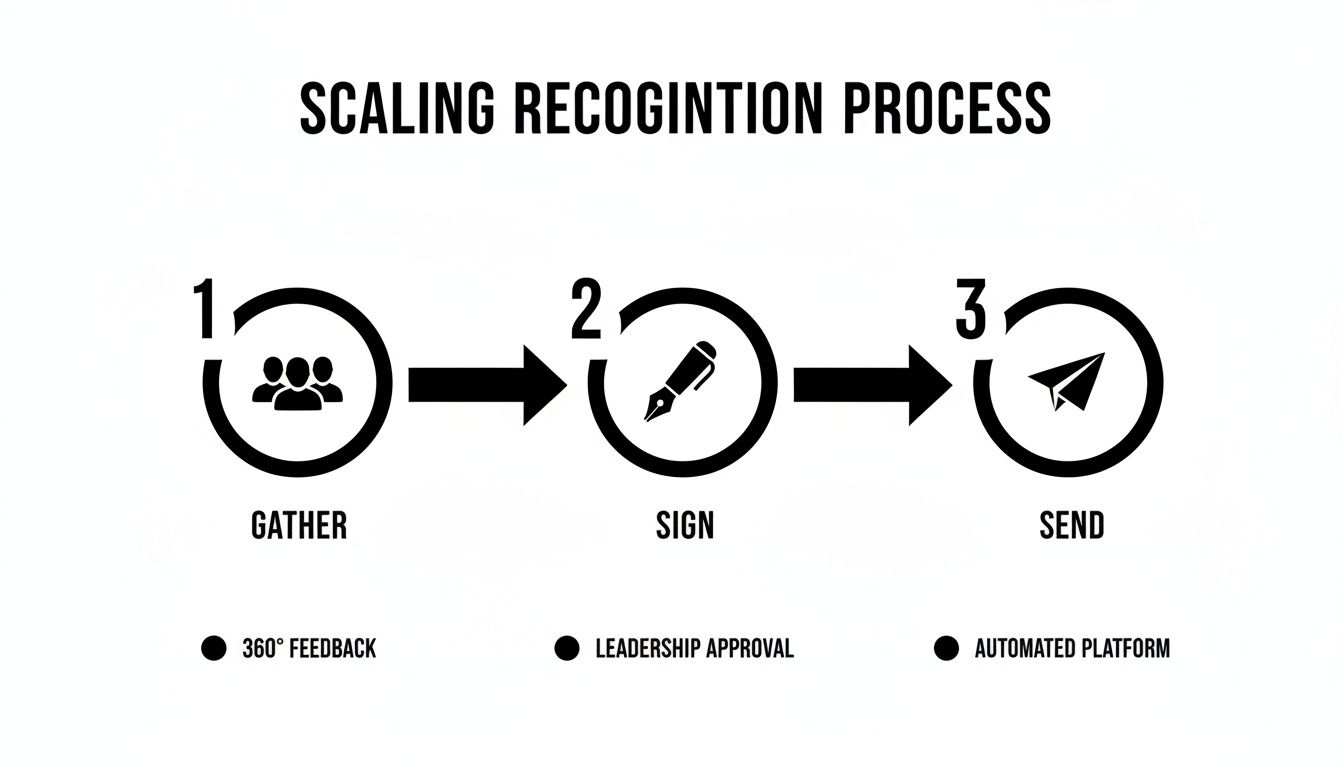
It highlights how digital tools can make life easier, allowing teams to quickly gather messages, sign, and send something like an online leaving card without any fuss.
Numbers tell you what is happening, but the stories from your people tell you why. You absolutely need safe, reliable channels for employees to share their honest experiences to understand the context behind your metrics.
Pulse surveys are fantastic for this. They are short, frequent questionnaires—often just 2-5 questions—that you can send out monthly or quarterly. They're perfect for getting real-time feedback on specific things, like how people feel about their manager or a recent company change.
And don't underestimate the power of a good exit interview. When they're conducted by a neutral person (like someone in HR), they become a treasure trove of candid insights into your culture. It's your last, best chance to understand what pushes people to leave and what might convince others to stay.
Honestly, the most powerful way to improve employee satisfaction costs absolutely nothing: building a culture where genuine recognition is just part of how you operate.
It starts with empowering managers to give specific, timely praise. Then, introduce a simple peer-to-peer system. Consistent, heartfelt acknowledgement has a massive impact on morale, and it won't touch your budget. You can even use free tools to help, like a Firacard for team celebrations where everyone can chip in on a memorable ecard.
The big annual survey still has its place, but you can’t rely on it alone. To get a real feel for the pulse of the company, you need more frequent, lighter check-ins. Think quarterly, or even monthly. These quick surveys help you spot trends as they happen and sort out issues before they become major problems.
A pro tip? Don't forget to use natural milestones as feedback opportunities. Work anniversaries, the end of a big project, and even exit interviews provide incredibly valuable and candid insights into the employee experience.
With remote teams, you have to be deliberate about connection. You can’t just rely on bumping into people in the kitchen. Over-communicate company news, schedule regular (and optional!) virtual social events, and make sure digital recognition is a core part of your strategy.
This is where you can bridge the physical distance. Using a group online card for a birthday or sending a thoughtful virtual leaving card when someone moves on shows every single team member, whether they're in the United Kingdom or Australia, that they are seen, valued, and a key part of the team.
Ready to make recognition effortless and boost your team's satisfaction? Firacard lets you create and share beautiful group cards for any occasion in minutes. Start creating for free today!


Finding the right words for a 50th birthday can feel oddly difficult. You want to honour a major milestone without making the message sound like a
You've just heard that someone you care about has lost a parent. The funeral is approaching, friends are scattered across cities, and nobody w
You can have hundreds of friendly contacts and still feel unsure who would answer when life gets messy, so what makes a friendship good, and how ca