50th Birthday Wishes: 8 Meaningful Templates
Finding the right words for a 50th birthday can feel oddly difficult. You want to honour a major milestone without making the message sound like a


Oct 3, 2026 | 10 Min Read
You can have hundreds of friendly contacts and still feel unsure who would answer when life gets messy, so what makes a friendship good, and how can you tell before you need it most?
The quality of friendship is the difference between people who merely know your name and people who know how you think, what you fear, and when to show up without being asked. It's less like collecting contacts and more like tending a shared garden, where trust, care, and time strengthen the roots. That makes friendship quality something you can notice, describe, and improve, not just a vague feeling you either have or don't.
A strong friendship isn't measured by how many names sit in your phone. It's measured by whether you feel known, trusted, and supported over time.
A friendship is like a garden. A lot of acquaintances are like scattered seeds, pleasant enough to look at, but easy to lose track of. A high-quality friendship is the soil, the seasons you've weathered together, and the quiet confidence that the roots will still hold when winter comes.
That's why quality of friendship is easier to recognise in behaviour than in mood. You can look for whether someone listens properly, keeps confidence, follows through, and stays steady when things are awkward. Feelings matter, of course, but behaviour tells you whether the bond has real structure.
The useful part is that structure can be improved. If you know what strong friendship looks like, you can notice what's missing and decide what to do next. That's the path this guide takes, from research to self-check to small habits that help real relationships deepen.
Practical rule: if a friendship only feels good when life is easy, it may be pleasant, but it's not yet proven.
The clearest message from UK data is simple, one high-quality friendship can matter more than a long friend list. That matters because people often chase numbers, while their wellbeing depends on trust, reciprocity, and emotional depth.
The UK's Office for National Statistics found that in 2011/12, 95% of adults aged 16 and over reported having at least one close friend, and 68% said they had between 2 and 6 close friends. The same work showed that around 93% had a friend they could confide in, 92% had a friend who supported them, and 90% had a friend they could relax and have fun with, which makes the point plain, the best friendships are active relationships, not passive connections.
A more recent Belonging Study found that 69% of people in Great Britain were satisfied with the quality of their friendships, while only 5% were dissatisfied. It also found that 1 in 10 adults had no close friends, rising to 20% among unemployed people versus 9% among those in work Belonging Study 2025. That gap matters because it shows how friendship quality is tied to everyday stability, not just personality.
| Finding | What It Means For You |
|---|---|
| 95% of UK adults had at least one close friend in 2011/12 | Most people have friendship in their life, but that doesn't tell you whether it feels reliable |
| 93% could confide in a friend | Trust is a practical sign of quality, not a bonus feature |
| 69% were satisfied with friendship quality in Great Britain | Many people are content, but not everyone, so it's worth checking your own bond rather than assuming |
| 1 in 10 adults had no close friends | Having no close friend is a real social risk, not a rare edge case |
The reason group greetings can matter so much is that they create a shared moment of attention, which is often what close friendships need most. The deeper point is that reciprocity and trust protect people better than likes, passive contact, or occasional proximity.
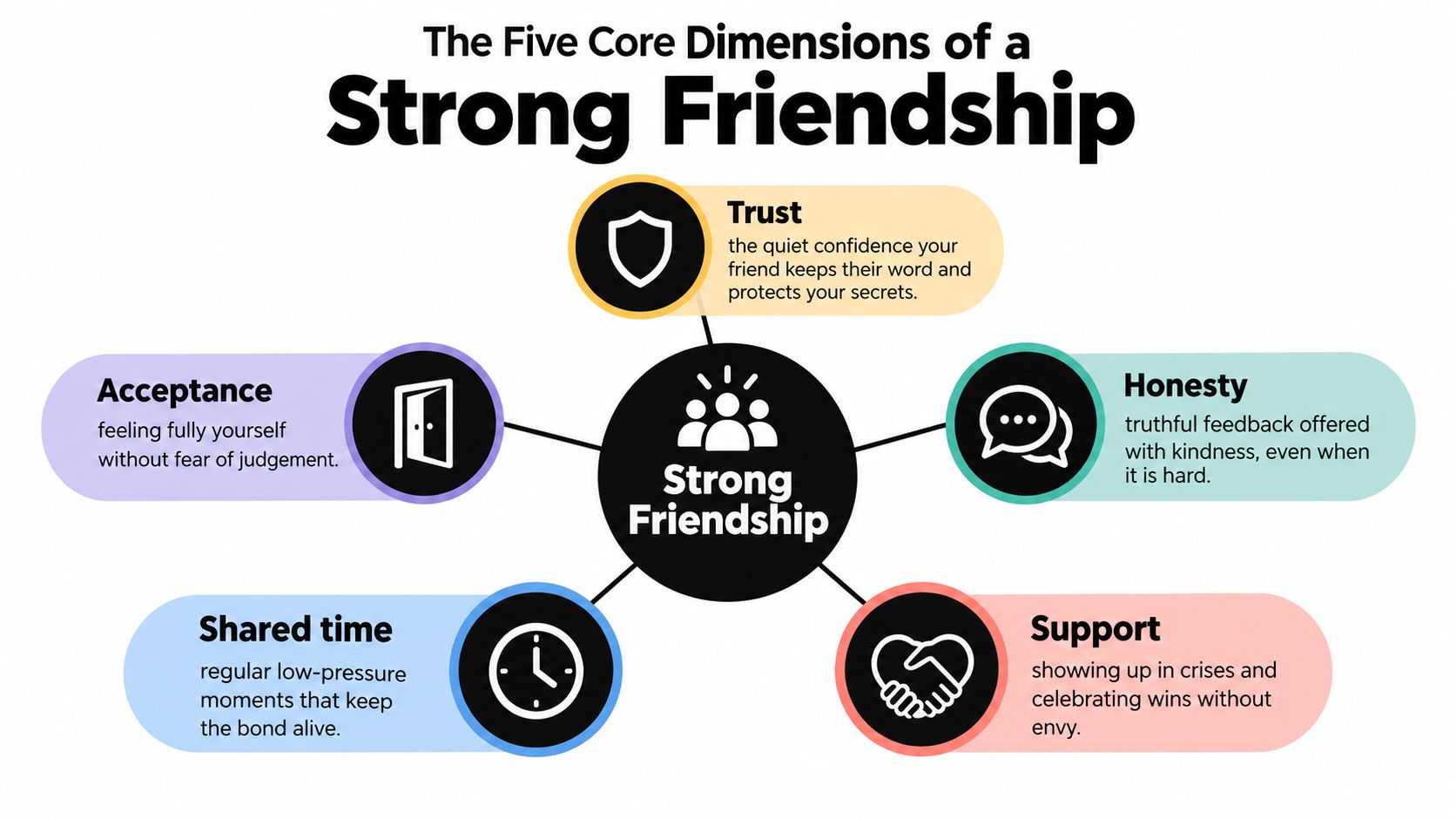
Trust is the quiet confidence that a friend will keep your confidence and act in your interest. If you tell someone something vulnerable on a hard day, trust is what lets you breathe again afterwards because the thing stays safe.
Honesty sits beside it. A trustworthy friend doesn't just agree with everything, they tell the truth kindly when it matters. That's different from being blunt, and it's different from being flattering.
Support means showing up in a rough patch and celebrating the good stuff without envy. It can look like practical help, a phone call after bad news, or a message that says, “I'm proud of you,” with no hidden agenda.
Shared time is less dramatic, but it matters just as much. Two people who regularly share low-pressure moments, a walk, a coffee, a quick voice note, often keep the bond alive more easily than people who only meet when something goes wrong.
Shared values don't require total agreement. They mean you have enough common ground that you don't have to translate yourself every time you speak.
Communication is the glue. It includes the ability to say what's true, repair after conflict, and understand a silence when words aren't there yet. Listening well is part of that repair work, because friends who can hear each other properly can usually recover faster after strain.
A friendship doesn't need to be perfect across all five dimensions. It needs enough strength in most of them to stay steady when life gets uneven.
Three close friends can all feel different. One may feel easy, one may feel dependable, and one may leave you oddly drained even though nothing obvious has gone wrong. That difference is worth noticing.
Take one friendship at a time and give each dimension from the previous section a mental score from 1 to 5. A 1 means the area feels weak, a 5 means it feels strong, and anything below 3 is information. It tells you where attention is needed, not that the friendship has failed.
Then ask yourself three simple questions:
You can also watch a few lightweight signals over a month. Does this person initiate sometimes, or do you carry the whole rhythm? When you disagree, do you repair properly, or do things freeze? After spending time together, do you usually leave feeling lighter, or more tense than when you arrived?
One awkward interaction doesn't mean much. A pattern does.
If you keep noticing that one person only appears when they need something, that tells you something about reciprocity. If another friend is steady in hard moments but awkward in light conversation, that tells you something else. The point is not to grade people harshly, it's to understand what each bond naturally gives and where it needs care.
This kind of honest reflection becomes easier when you're also building new connections with intention. That matters because awareness only helps if it leads to a next step.
Small actions usually do more than grand gestures. The friendships that last are often built by repeat contact, thoughtful listening, and enough vulnerability to make the bond feel real.
Recurring contact helps because it removes the burden of constant re-planning. A monthly call, a standing walk, or a regular voice note thread gives the friendship a rhythm.
Active listening matters too. Ask one follow-up question before you change the subject. Name something specific you appreciated. Share a little more than you normally would, even if it feels mildly awkward at first. Being kind consistently often looks small in the moment, but it gives the relationship a dependable shape.
In remote teams, friendships often grow through structure, not spontaneity. Regular one-to-ones, paired coffee chats, and small shared rituals can turn polite contact into real familiarity. In schools, the same principle shows up in peer mentoring and cooperative learning, where repeated roles give students a reason to know one another beyond the surface.
If someone is already struggling with low mood or loneliness, support needs to be gentle and practical. A resource like counselling for depression in Penticton can sit alongside friendship, not replace it, when someone needs more than a friend can provide.
The habit to build is simple, show up a little more often than feels necessary, and say one honest thing instead of three vague ones.
Firacard gives friends a way to create a collaborative card with messages, photos, GIFs, and videos, which fits well when people are separated by distance. A group can invite contributors by link, write privately, and send one digital or printed card on a chosen date, which makes appreciation feel shared rather than scattered.
What turns a thoughtful message into evidence of friendship? Specific memories, shared effort, and words that connect to the relationship's real history.
A group card gives those qualities a practical form. For a birthday, friends in different places can each contribute one memory or thank-you. The recipient receives more than a greeting. They see how trust, reciprocity, and shared values have appeared in ordinary moments.
A virtual leaving card can carry the same meaning for a colleague changing jobs or moving house. One person might recall an inside joke, another could name a value they shared, and a third might describe the colleague's effect on the team. Each message acts like a tile in a larger picture, showing a fuller relationship than one writer could describe alone.
When you want to mark a birthday or thank-you at a distance, a personalized ecard for a friend lets each contributor add a specific memory to one shared card. Firacard supports messages, photos, GIFs, and videos, with an invite link for contributors and a chosen delivery date.

A digital leaving card, group greeting card, or personalized ecard matters because it helps distant friends act on what they already understand about the friendship. Screenshot from https://firacard.com/dashboard/group-card/create
The simplest definition of quality of friendship is this, it's the felt experience of being known, trusted, and supported over time. The research backs that up, friendship quality is tied to confidence, belonging, and wellbeing far more than friend count alone.
So pick one friendship and run a quiet check across the five dimensions, trust, honesty, support, shared time, and communication. Then choose one action you can do within seven days, a long call, a specific thank-you, or a group card that lets other people add their voices too.
Friendship quality is usually grown in ordinary moments. A short message sent on time, a memory named clearly, a conversation that goes one layer deeper, these are the things that keep a bond alive.
Firacard helps you turn that kind of care into something people can open, read, and keep. If you want a simple way to act on what you've just thought through, visit Firacard and use it to gather the messages, memories, and appreciation that make a friendship feel real.


Finding the right words for a 50th birthday can feel oddly difficult. You want to honour a major milestone without making the message sound like a
You've just heard that someone you care about has lost a parent. The funeral is approaching, friends are scattered across cities, and nobody w
A couple realises that their 15th wedding anniversary is only weeks away. The restaurant they meant to book is full, the obvious gift ideas feel re