50th Birthday Wishes: 8 Meaningful Templates
Finding the right words for a 50th birthday can feel oddly difficult. You want to honour a major milestone without making the message sound like a


Sep 28, 2026 | 20 Min Read
A student can attend every session, keep their camera on and still feel invisible. They may avoid speaking because the first contribution feels risky, or because the format rewards the quickest and loudest voices. A well-designed shared activity changes that dynamic. A short reflection, peer response or collaborative message gives more students a safer, visible way to take part.
Student engagement is broader than attendance. It includes participation, belonging, contribution and follow-through across classrooms, hybrid courses, online communities and student organisations. England's largest pupil engagement study, based on over 100,000 pupils, found that more than one in four pupils began to disengage during Year 7. Average school enjoyment fell from about 6.0 in Year 6 to 3.8 in Year 7 and 3.2 in Year 8, while pupils in the top 25% of engagement scores in November 2024 were 10 percentage points less likely to be persistently absent than pupils in the bottom 25% (ImpactEd's engagement report).
The following best practices for student engagement connect sound teaching with community rituals and recognition. Each idea includes an example, a practical trade-off and metrics to review. Collaborative digital recognition, such as a Firacard group greeting card, can support that work, but it won't replace good teaching, accessible support or trusted relationships. A useful starting point is to make participation feel meaningful, including through a landing within Vanta's platform when student activities involve teams, clubs or shared interests.
A shared digital activity gives students a defined role in recognition and community life. Instead of receiving a one-way announcement, they contribute a message, image, video or GIF to a collective project. The prompt may be academic, social or reflective, but students should understand whom they are supporting and why their contribution matters.
A student organisation might create a virtual leaving card for graduating seniors. In a hybrid class, classmates can add birthday messages to a group ecard while remote students take part on equal terms. A university club could collect appreciation messages for a volunteer coordinator using Firacard's online group card guidance. Students are helping produce the shared moment, not just watching it.
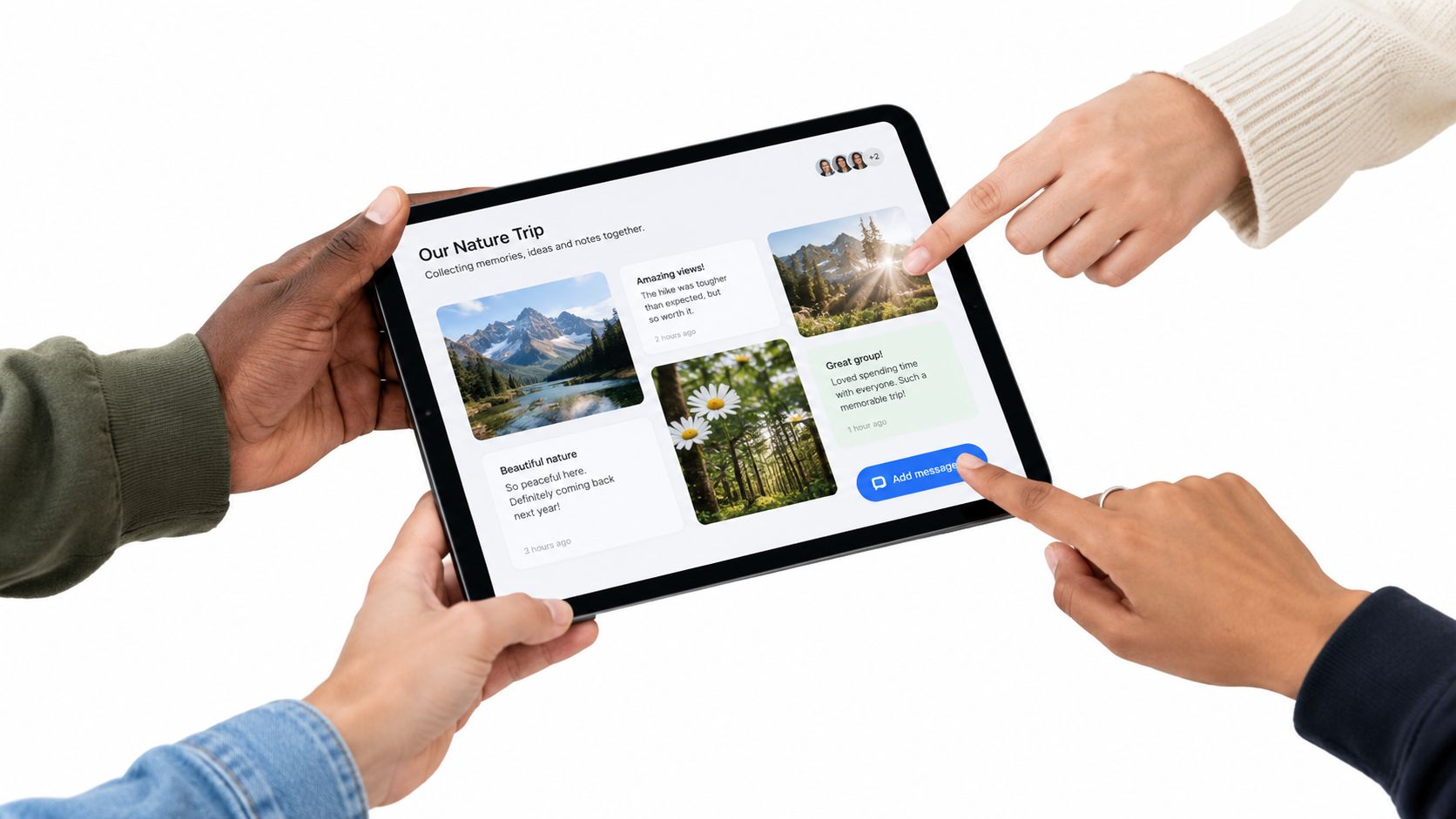
Set one clear prompt, a deadline and a visible example. Keep the first action small, such as asking each student to share one memory or name one contribution. Explain how the finished project will be used, whether in a class meeting, online gathering or student organisation event.
Practical rule: If students need a long explanation before contributing, simplify the invitation before launching it.
Use a short contribution window and offer an alternative for students who cannot attend live. Assign a moderator to remove unsuitable content and check whether participation is concentrated among the same few voices. Review invitation reach, contribution rate, distribution across the group and completion by the deadline.
The trade-off is that digital participation can become superficial when prompts are vague or public contribution feels risky. Ask for one specific memory, one example of service or one hope for the recipient. That structure gives students a manageable way to contribute while preserving room for personal expression.
Recognition has more effect when it arrives close to the moment it describes. A farewell delivered weeks after a student leaves feels administrative. A message sent at a transition point can help the student feel that their contribution has been noticed.
Build recognition into the academic calendar. An international school might organise a virtual leaving card for an exchange student moving to another country. A graduate programme could create a digital appreciation card for a faculty adviser, while a sports team coordinates birthday ecards for teammates training in different locations. Student unions can also recognise outgoing officers with personalised messages rather than a generic announcement.
Create a calendar of birthdays, course completions, leadership transitions, volunteering milestones and farewells. Firacard's scheduling feature can help coordinators prepare a card in advance and deliver it at a suitable time. A graduation celebration ideas resource can help teams shape the occasion around the student rather than around the platform.
Invite contributions from students across locations and time zones, and combine text with photos, video or GIFs where appropriate. A high-resolution download can provide a lasting keepsake, including for recipients who prefer to print or frame a card.
The trade-off is that frequent recognition can feel routine. Keep the format consistent, but vary the prompt and the people invited to contribute. Monitor delivery timing, the number of contributors, the proportion of invited groups represented and short qualitative responses from recipients. Recognition shouldn't become a performance score. It should reinforce that people matter to the community.
Peer feedback becomes more useful when students know what good feedback looks like. “Well done” may feel pleasant, but it gives the recipient little information. A prompt such as “Describe one contribution that helped the project and one strength to carry into the next task” produces more actionable input.
Project-based learning teams can collect messages recognising individual contributions. Mentoring programmes can invite mentees to describe how a mentor helped them. Leadership programmes might use a group greeting card as a structured celebration of growth, rather than presenting feedback as a formal judgement. Guidance on feedback collection methods can help coordinators choose between attributed and more private approaches.
Set norms for respectful, specific and actionable contributions. If feedback might be sensitive, use a password-protected board and explain who will review submissions. Moderation isn't censorship. It's a safeguard against embarrassment, personal attacks and comments that the recipient wasn't prepared to receive.
Students contribute more openly when they understand the prompt, the audience and the moderation process.
A useful workflow is to invite responses, review them, remove material that conflicts with community values and compile the final card for a planned delivery moment. Celebrate the quality of the feedback, not only the recipient. That tells students that thoughtful observation is itself a valued contribution.
Measure response completion, the spread of contributors across peer groups, the usefulness of comments in follow-up conversations and whether students choose to use the process again. The trade-off is time. Moderation requires staff or student-leader capacity, especially when a card carries emotional or developmental feedback.
A participation activity isn't inclusive because it happens online. Students may face different access needs, schedules, devices, communication preferences and confidence levels. Offer more than one route into the activity, and make every route clear.
An international student programme can coordinate a group online card across multiple time zones. A school can let a student with a speech or motor disability contribute through an image, video or pre-recorded message. A hybrid university can include remote and in-person students in a farewell for a graduating cohort. A multilingual student association can welcome contributions in different languages and preserve that variety in the finished card.
Offer written text, images, GIFs, video and audio where the platform supports them. Use plain instructions, explain the expected length and show an example. Announce the opportunity early so students with work, caring or accessibility needs aren't forced into a narrow response window.
Firacard's group online card feature can support multimedia contributions and bulk recognition programmes. Before a large campaign, test the experience on common devices and browsers. Provide a short tutorial or a named contact for technical help.
The trade-off is that more formats create more moderation and accessibility work. Add captions or transcripts where needed, check image descriptions and avoid making video the only meaningful option. Measure participation by location, study mode and contribution format, while handling personal data carefully. A higher overall response can hide exclusion if only confident, well-connected students take part.
Generic praise often sounds like an obligation. Personalisation makes recognition more credible because it reflects the relationship, the person and the context. Students should have room to choose the tone, visual style and details that matter to them.
A student club could create a personalised ecard around a member's interests and shared jokes. A graduation committee might use school colours, inside references and ambitions contributed by the graduating class. Mentors can choose a theme that reflects their relationship with mentees, while residence teams can recognise an outgoing resident assistant through specific examples of their leadership.
Invite contributors to share a memory, a lesson, a quality they admire or a moment that changed the group. Photos, videos and GIFs can add texture, but they shouldn't replace meaningful words. A personalised ecard guide can support coordinators who want to create something more individual than a standard template.

Offer varied templates and invite the recipient's input where timing allows. A graduating student might care as much about the message design as the words, in the same way they might enjoy decorating your graduation cap. Make clear that every contribution is distinct and valuable.
The trade-off is coordination. More choice can slow approval and make the result less uniform. That's acceptable when authenticity matters more than speed. Review the specificity of messages, recipient feedback and participation across different friendship groups. If the same few students always contribute, change the invitation and offer private or asynchronous options.
Students engage more fully when an activity serves a shared purpose. Recognition can become a small community ritual, particularly when students contribute to something larger than an individual classroom task.
A large university might run a staff appreciation campaign using a bulk group greeting card. Student government can invite contributions to a group online card for graduating officers. A nonprofit working with student volunteers can collect appreciation messages for community partners. An international student association can use a virtual leaving card to mark the end of a semester abroad and the return home.
The activity matters, but the explanation matters just as much. Tell students why the community is recognising someone, what value that person represents and how their contributions will be presented. A shareable link can reduce friction, while visible progress updates can build momentum without turning participation into a competition.
Invite contributors to a livestream, class presentation or group viewing when appropriate. Decide whether names should be visible or contributions anonymous. Archive the finished card as a community artefact, with privacy settings that match the recipient's wishes.
Firacard also highlights a partnership with One Tree Planted, through which each paid card supports tree planting. That environmental connection can give a recognition campaign an additional collective purpose, but it shouldn't distract from the human reason for the activity.
Measure contributor spread, repeat participation, attendance at the presentation and student descriptions of belonging. The trade-off is visibility. Public campaigns can encourage participation, but some students may prefer private contribution. Offer both wherever practical.
Not every valuable engagement moment is academic. Students build belonging through low-pressure contact, shared humour and small rituals that make a group feel familiar. Birthday messages, welcome notes, farewell gatherings and course milestones create natural openings for that connection.
An online degree programme can coordinate a virtual leaving card for a graduating cohort. A student housing community can welcome new residents and acknowledge birthdays throughout the year. Club officers can celebrate a meeting anniversary, fundraising achievement or community service milestone with a group greeting card. Distributed teams outside education use birthday ecards in a similar way, showing how simple rituals can maintain connection across distance.
Make the contribution request brief and enjoyable. Ask for a favourite memory, a GIF, a one-line message or a photo. Firacard's birthday ecard templates can reduce setup time, while scheduled delivery can place the celebration inside a class session, team meeting or community event.
Share the finished card in the space where the group already interacts, such as a course channel or student organisation forum. Don't require every student to participate, and don't treat silence as disengagement. A student may care greatly but have limited time, privacy concerns or a different comfort level with public messages.
Review participation rate, the variety of contributors and whether students return for later community events. The trade-off is that informal activities can become exclusionary if the same friendship circles dominate. Rotate invitations, make prompts accessible to newcomers and ensure that recognition isn't limited to highly visible students.
Students take emotional risks when they trust the setting. A farewell message, appreciation note or peer reflection can feel exposing if students don't know who will read it, whether it will be edited or how it will be presented.
State the purpose and boundaries in the invitation. For a school farewell, ask students to share one specific memory and one quality they admire. For a sorry for leaving card, focus on the person's contribution to the community rather than guilt-tripping them about their departure. For a birthday ecard, explain that contributions will be moderated so the finished message remains celebratory and appropriate.
Provide two or three examples that demonstrate the tone and depth required. Explain whether names appear, who can access the board, when moderation happens and what will be removed. A password-protected board is appropriate when comments might be sensitive or vulnerable.
Trust depends on process: Tell contributors what happens after they press submit.
Test the form yourself before sharing it. Set a deadline that leaves enough time for review, and publish the moderation approach in plain language. The trade-off is that safeguards can make a spontaneous activity feel formal. Keep the rules short, but don't omit them. Measure incomplete submissions, moderation issues, student confidence in the process and recipient comfort after delivery.
Recognition survives when someone remembers to run it. The most sustainable approach is to attach it to routines that already exist, such as graduation planning, officer transitions, morning meetings, Friday reflections or team onboarding.
A university can make a bulk farewell card part of its graduation process. A student organisation can add digital leaving cards to its annual officer handover. A school can include group online cards in existing classroom birthday routines. Each example works because the coordinator isn't building an entirely new programme. They're adding a defined step to a familiar moment.
Audit the community calendar and choose a small set of meaningful recognition opportunities. Begin with one use case, document the steps and train the people who will run it. Templates and shareable links can reduce administrative effort, while bulk options may help larger schools or student organisations manage repeated campaigns.
Add the workflow to a handbook or official calendar. Track invitation delivery, time required from the coordinator, contribution completion and repeat use. The trade-off is flexibility. A standard process creates reliability, but it can become mechanical. Review the prompt and presentation each cycle so the ritual stays connected to the students involved.
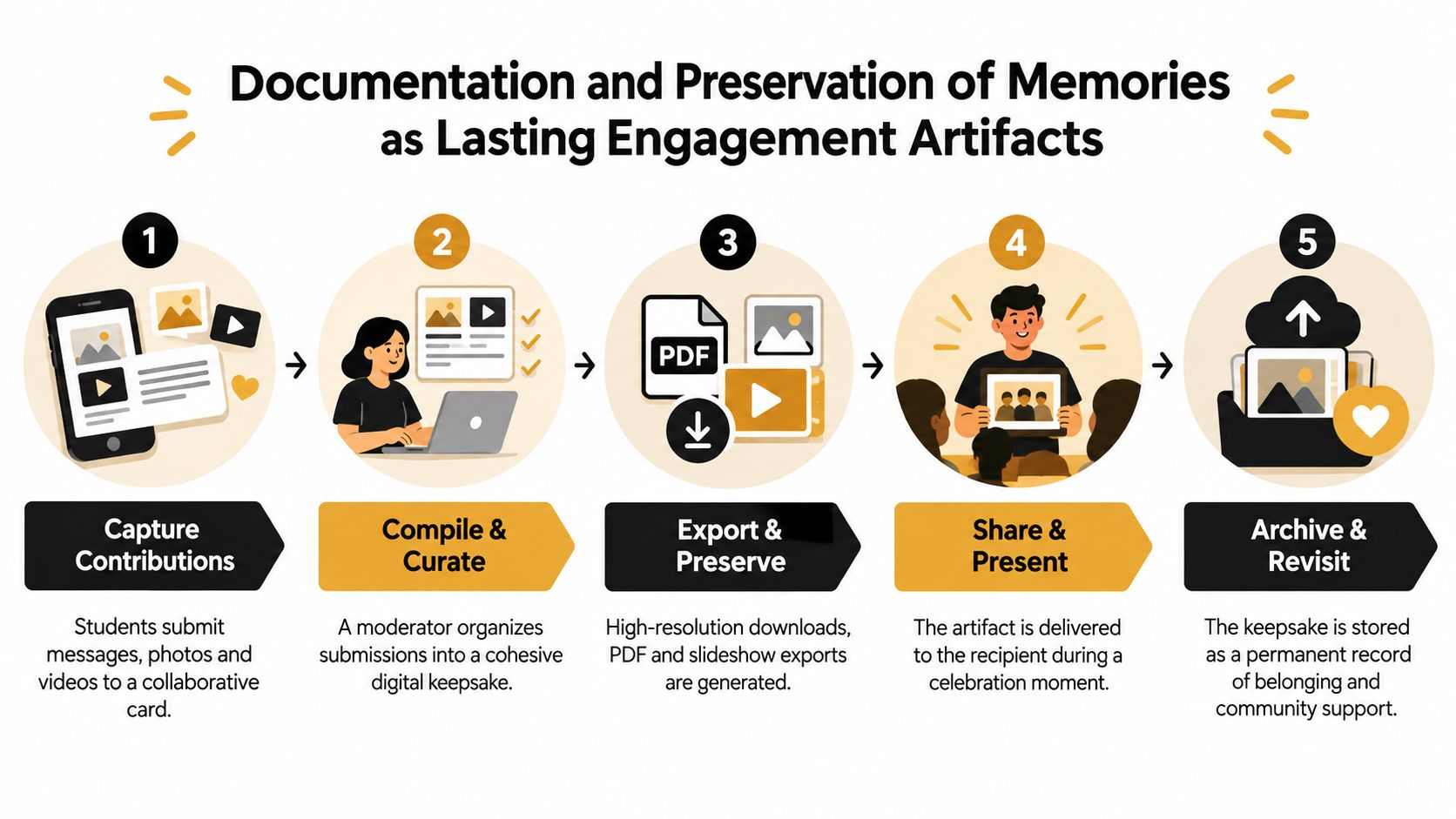
The value of a recognition activity can continue after the delivery moment. A saved message can remind a student of peer support during a difficult transition, a new course or a period of uncertainty. It can also preserve the history of a student organisation's people and values.
Graduating students might download a high-resolution personalised ecard or slideshow and share it with family. An outgoing officer can keep a virtual leaving card as a record of their term. A student organisation can archive cards from leadership transitions, while friends separated by distance can print a group greeting card for a dormitory or flat.
Tell contributors during the invitation that their messages may become a digital keepsake. Firacard supports downloadable formats and slideshow export, allowing a finished card to be presented at an event or saved for later. Recipients who want a physical reminder can print a high-resolution version, while an organisation can store cards by occasion and year.
Set an archive policy that reflects the organisation's needs and the recipient's consent. The proposed retention period might be defined internally, for example, keeping organisational cards for a limited period while respecting privacy. Use password protection for sensitive material and avoid publishing personal messages without permission. A resource on how to capture your life story today offers a useful reminder that preserved memories can carry meaning beyond the original event.
Measure retrieval, recipient use and whether archived artefacts inform later community activities. The trade-off is permanence. Saving everything can create privacy and storage concerns, while saving nothing loses context. Preserve deliberately, explain the policy and give recipients a choice where possible.
| Practice | Implementation complexity | Resource requirements | Expected outcomes | Ideal use cases | Key advantages |
|---|---|---|---|---|---|
| Interactive Digital Participation and Collaborative Contributions | Moderate, set up collaborative boards and templates | Devices, internet, digital literacy, moderation time | Higher engagement, collective ownership, varied expression | Group projects, hybrid celebrations, class collaborative cards | Real-time collaboration, multimedia contributions, shared keepsakes |
| Timely Recognition and Celebration of Milestones | Low–Moderate, scheduling and template use | Scheduling tools, templates, coordination across contributors | Increased morale, sense of belonging, memorable moments | Birthdays, farewells, achievements, anniversaries | Instant or scheduled delivery, broad recognition, downloadable keepsakes |
| Peer Feedback and Constructive Community Input | Moderate–High, facilitation and moderation required | Moderation tools, prompts, anonymity settings, facilitator time | Actionable insights, improved emotional intelligence, stronger bonds | Mentorship, leadership programs, project retrospectives | Structured feedback, safe sharing options, curated perspectives |
| Inclusive and Accessible Communication Across Diverse Populations | Moderate, accessibility and format accommodations | Multi-format support, device/browser testing, support resources | Equitable participation, cultural responsiveness, accessibility | International cohorts, neurodiverse groups, hybrid programs | Multiple contribution channels, removes geographic/time barriers |
| Personalization and Student Voice in Recognition | Moderate, custom templates and coordination | Design templates, multimedia uploads, extra time for customization | More sincere, memorable recognition; greater student ownership | Personalized birthdays, graduation cards, mentor appreciation | Authentic voice capture, tailored keepsakes, higher perceived impact |
| Community Building Through Shared Purpose and Collective Contribution | Moderate–High, scale coordination and promotion | Bulk options, shareable links, campaign comms, moderation | Stronger community identity, shared rituals, inclusive participation | University-wide campaigns, student government initiatives | Scalable engagement, collective achievement artifacts, ritual building |
| Structured Opportunities for Informal Peer Connection and Social Bonding | Low, simple setup, casual templates | Basic templates, minimal facilitation, multimedia options | Authentic peer relationships, positive culture, increased belonging | Casual birthdays, welcomes, club social moments | Low barrier to participate, fun tone, quick setup |
| Clear Communication of Expectations and Psychological Safety in Contributions | Moderate, guidelines and moderation workflows | Moderation tools, clear prompts/examples, privacy controls | Safer contributions, higher-quality content, reduced anxiety | Sensitive farewells, feedback rounds, high-stakes recognition | Protects vulnerability, improves appropriateness, builds trust |
| Integration of Celebration Into Existing Workflows and Community Rhythms | Moderate, map workflows and enable integrations | API/integration support, templates, coordinator training | Sustainable recognition, higher adoption, consistent practice | Graduation processes, routine transitions, HR recognition | Low-friction adoption, scalable, aligns with existing routines |
| Documentation and Preservation of Memories as Lasting Engagement Artifacts | Low–Moderate, export and archival setup | Storage, export tools (PDF/slideshow/high-res), privacy protocols | Lasting keepsakes, community history, resilience support | Graduation archives, alumni memorabilia, organizational records | High-resolution exports, retrievable artifacts, print- and share-friendly formats |
The strongest engagement programmes don't rely on one exciting activity. They remove barriers, offer meaningful choices, create regular opportunities for staff-student and peer-to-peer contact, and preserve what students create together.
UK higher education evidence supports the value of repeated interaction. Advance HE's UK Engagement Survey found that 38% of students said they saw staff often or very often in 2022, compared with 33% in 2021 and 36% in 2020. In the same survey, 44% said they were encouraged to collaborate with staff often or very often, and 47% said they worked with fellow students often or very often (Advance HE's engagement findings). These figures point to a practical principle. Engagement improves when institutions engineer regular contact, not when they only describe participation as a broad aspiration.
Digital infrastructure also needs to work. In Jisc's 2024/25 UK higher education survey, 86% of students rated their digital learning environment as above average, 84% rated the quality of the digital learning experience positively and 77% rated support for learning with technology as above average, with that last measure up 5 percentage points year on year (Jisc Digital Experience Insights). A digital card or collaboration board should sit inside that support structure, with clear access instructions and help for students who need it.
Surveys and attendance records are useful, but they won't show every form of contribution. UK-facing guidance highlights face-to-face engagement, effective surveys and clear communication, while also warning that feedback questionnaires can overstate certainty or miss differences between staff, pupil and leader perceptions (UK student engagement evidence base). Combine quantitative and qualitative signals:
Start with one low-friction use case, such as a structured peer recognition activity or a scheduled group card. Define the purpose, write an inclusive prompt, choose synchronous or asynchronous participation, moderate thoughtfully, celebrate the result and review the next cycle. Repeat the process with one measured improvement rather than launching a large programme without a clear owner.
The approaches can also support different settings. UCL's IDEA resource provides 19 activities for face-to-face or online teaching, with guidance on when to use each activity, workload, setup time, digital tools and required resources (UCL IDEA digital engagement resource). The University of Hertfordshire's toolkit describes a high-impact, low-technology approach with cards that can be adapted to subject disciplines and used in face-to-face, virtual or remote delivery (University of Hertfordshire engagement toolkit). The lesson is not to add technology for its own sake. Choose the activity that fits the relationship, the learning purpose and the community rhythm.
For a school, university or student organisation, the planning sequence is straightforward. Choose a purpose, define an inclusive prompt, decide whether students can contribute live or asynchronously, set expectations, moderate with care, present or deliver the result, preserve it appropriately and refine the next cycle using evidence. Small contributions become powerful when students can see where they fit, what their voice changed and how the group remembers their involvement.
Firacard offers collaborative online group cards where students can add text, photos, GIFs and videos, invite peers through a shareable link and schedule or deliver the finished card. Visit Firacard to explore group greeting cards for student birthdays, farewells, appreciation and community milestones across schools, universities and student organisations.


Finding the right words for a 50th birthday can feel oddly difficult. You want to honour a major milestone without making the message sound like a
You've just heard that someone you care about has lost a parent. The funeral is approaching, friends are scattered across cities, and nobody w
You can have hundreds of friendly contacts and still feel unsure who would answer when life gets messy, so what makes a friendship good, and how ca