50th Birthday Wishes: 8 Meaningful Templates
Finding the right words for a 50th birthday can feel oddly difficult. You want to honour a major milestone without making the message sound like a


Sep 26, 2026 | 12 Min Read
Bulk order discounts typically reduce per-unit costs by 20% to 50%, while digital group cards can offer scalable plans from free to enterprise tiers. The actual saving depends on how the supplier calculates the discount, whether VAT and delivery are included, and whether checkout rules let your team use the quoted price.
You're organising a farewell for a department spread across London, New York, Toronto, Sydney, and Bengaluru. Messages arrive in different formats, two people are missed, the physical card sits on someone's desk while remote colleagues wait, and finance asks why the final invoice doesn't match the headline offer. That's the operational reality behind large team celebrations.
For HR and People Operations teams, bulk order discounts aren't just a way to pay less. They're a procurement decision involving contributor limits, tax treatment, delivery, approval workflows, and the difference between ordering many cards and creating one collaborative card with many contributors. Get those mechanics right, and a team celebration becomes repeatable rather than exhausting.
A manager volunteers to organise a leaving card. At first, the task seems harmless. They buy a card, circulate it among nearby colleagues, chase remote staff for messages, and ask someone else to print the final version. Then the leaver's final day moves forward, a contributor is on annual leave, and the card must somehow reach someone working in another country.
The problem grows when a department wants to recognise several people. Physical cards bring recurring purchases, postage, storage, signing time, and the risk of excluding colleagues who never see the card. A digital online leaving card removes the handover problem, but only if the organisation can create a clear process for collecting messages and approving spend.

A physical card makes every contributor part of the logistics chain. Someone must know where the card is, who has signed it, when it needs to move, and how to deliver it. A dispersed team adds time zones, language differences, local purchasing rules, and uncertainty about whether colleagues have had a fair chance to participate.
A collaborative group greeting card changes the workflow. The organiser creates one board, shares an invitation link, sets a closing time, checks contributions, and sends the finished card on schedule. The same process can support a structured approach to bulk greeting cards in the UK without requiring every contributor to be in the same office.
Practical rule: Treat team recognition like a small procurement process. Define the recipient, contributors, delivery date, approval owner, and total landed cost before anyone starts signing.
The financial benefit appears when a business replaces scattered one-off purchases with an organised programme. A school may recognise staff throughout the year. A charity may run appreciation campaigns across several sites. A People team may need farewell, birthday, service, and promotion cards for employees in multiple countries.
Bulk pricing helps these organisations standardise purchasing. It can also improve inclusion because a colleague in India or Canada can contribute through the same link as someone in the UK. The best solution doesn't merely lower the card price. It reduces chasing, prevents missed messages, and gives finance a clearer record of what was bought and why.
A bulk order discount lowers the price per unit when a buyer commits to a larger quantity, a recurring programme, or a defined commercial tier. In physical retail, the saving often reflects lower packaging, handling, shelf, and fulfilment costs per item. In digital cards, the economics are different, but the principle remains: a supplier can serve an organised business account more efficiently than a series of unrelated individual purchases.
The UK government's Food Security Report, discussed in this UK analysis of bulk buying for resale, found that during the first nationwide COVID-19 lockdown consumers generally bought slightly more per shop, shopped more frequently, and added more long-life goods and staples. Bulk buyers remained a minority, and the sharpest change occurred immediately before the 23 March 2020 lockdown. That distinction matters. Uncertainty can increase basket size, but planned replenishment is a different buying behaviour from emergency stockpiling.
A larger pack can make fixed costs less significant per unit. UK retail commentary cites a government analysis in which a 4-pint bottle of milk had a unit price nearly 60% lower than a 1-pint bottle, as reported in this UK pension and retail pricing commentary. The larger pack doesn't make the milk itself magically cheaper. It changes how packaging, handling, and selling costs are distributed.
The same source states that wholesale volume discounts commonly range from 20% to 50% below smaller retail trade prices, while bulk purchases of non-perishable goods often deliver per-unit discounts of 25% to 50% or more. Those figures provide useful context for physical goods, but digital card buyers should not assume that every supplier applies the same range. Digital platforms may price by card bundle, contributor capacity, feature tier, recipient count, or account agreement.
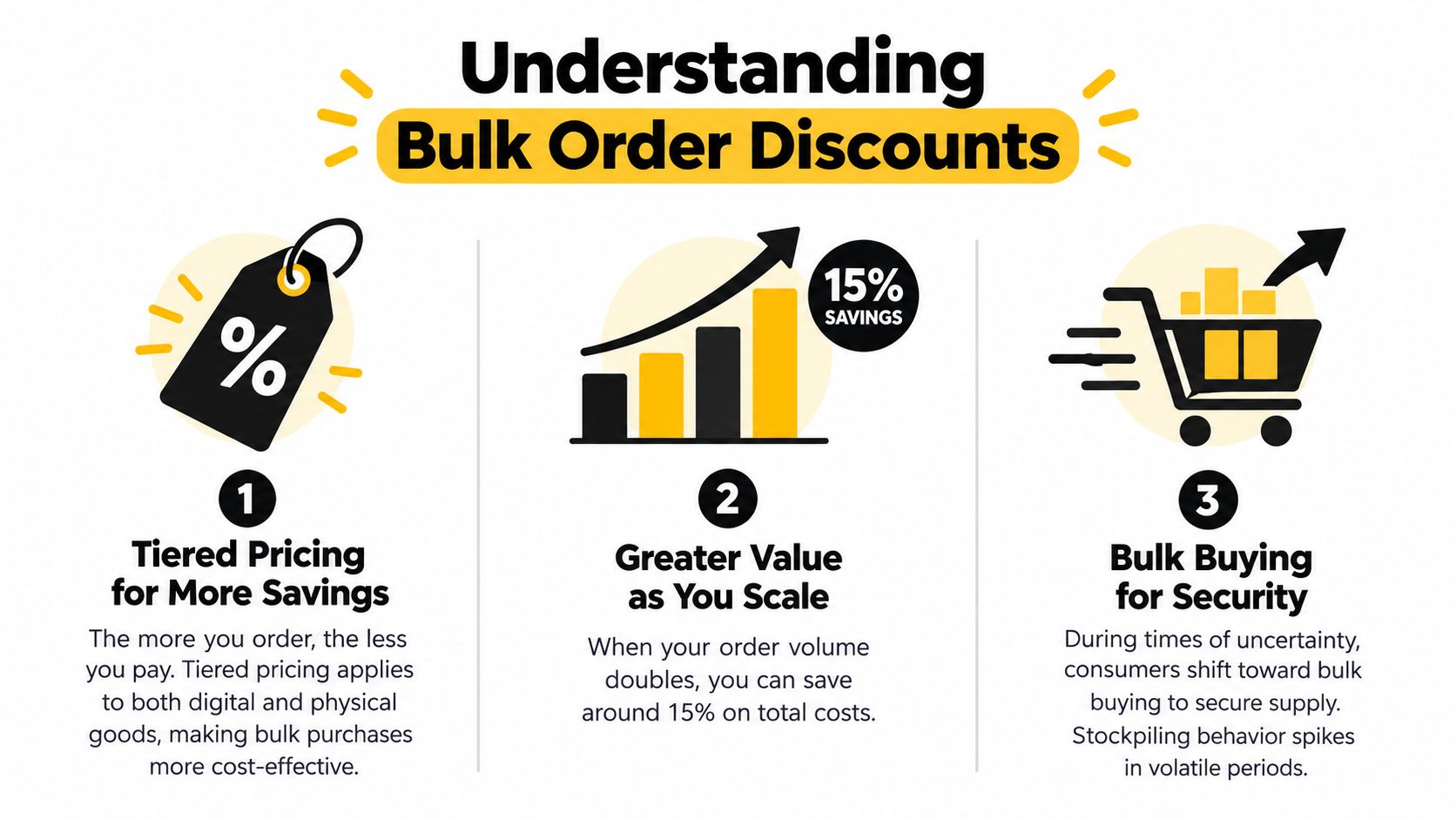
For a greeting-card programme, the useful comparison is not just “single card versus bulk card”. Compare the complete cost per delivered card, including VAT, payment fees, delivery, administration, and the time required to coordinate contributors. One collaborative card may replace many individual purchases, while a card bundle may serve repeated celebrations across a department.
Bulk buying works best when demand is predictable. Don't purchase a large bundle merely because the percentage looks attractive.
Suppliers use several pricing structures, and the headline percentage tells you very little without the rules beneath it. A discount may apply to each qualifying product line, the whole basket, a specific card bundle, or an account that reaches a minimum spend. These models can produce very different invoices.
One UK wholesale supplier describes a tiered schedule of 4% for 5 to 9 units and 12% for 15 or more units, with automatic application once an order reaches £10,000 ex VAT or five or more units of the same product, according to its explanation of trade-account discounts. The lesson is straightforward: quantity thresholds can change unit economics abruptly, so combining demand across teams or sites may be more valuable than negotiating a small additional percentage.
| Model | Description | Implication for Buyers |
|---|---|---|
| Quantity tier | The unit price falls at predefined quantity thresholds. | Aggregate genuine demand before ordering so the account reaches the right tier. |
| Minimum order value | The discount activates only after a stated spend, often measured ex VAT. | Check whether your internal budget is VAT-inclusive and compare like with like. |
| Per-line discount | Each qualifying product or card bundle is assessed separately. | A mixed basket may fail to qualify even when the total order is large. |
| Basket-wide discount | The supplier calculates eligibility across the complete order. | Mixed purchasing can help, but confirm which exclusions apply. |
| Negotiated account rate | A supplier offers custom pricing based on expected or committed volume. | Request written terms covering renewal, validity, invoicing, and fulfilment. |
UNIQLO's UK bulk-order terms demonstrate why fine print matters. Its 10% discount applies only to orders of £5,000 or more, requires 10 or more units of each product, and excludes reduced-price, limited-time-offer, and collaboration items, as set out on its bulk-order information page. Another UK seller calculates its discount per product line rather than across the basket. For procurement teams, those are not minor technicalities. They determine the actual saving.
When comparing employee-recognition tools, check the commercial model alongside the features. A team assessing workplace platforms may also find it useful to view pricing page for a separate reference point on how software suppliers present plans and account costs. For digital cards specifically, document whether you're buying cards, contributor access, recipient capacity, or a combination.
Use the guide to bulk group greeting card pricing as a prompt for the questions your finance team should ask before approving an order.
Don't begin negotiations with “Can you do better?” Give the supplier a usable commercial brief. State the number of cards or campaigns you expect, the countries involved, the likely purchase period, the approval process, and whether you need one invoice or separate cost centres.
Start by collecting demand from the people who run recognition activities:
The point isn't to promise volume you won't use. It's to show the supplier the genuine pattern of demand and ask whether a programme rate, bundle, or account arrangement fits it.
Ask five direct questions before accepting a quote:
Delivery and checkout can erase an apparently strong saving. UK retail examples include free-delivery thresholds above £39 for one bulk retailer, while another supplier warns that express checkout may prevent a discount code from appearing. Amazon Business UK applies discounted referral fees only when a single-product order exceeds £1,000 and the buyer meets a minimum 3% price discount condition, showing how platform rules can affect commercial outcomes, as described in this bulk-order pricing example.
For a broader framework on whether the operational gain justifies the purchase, use this business value assessment resource. Ask for a sample invoice, not just a percentage, and have finance approve the exact route your organisers will use.

Firacard is one option for teams that want a collaborative digital card workflow rather than a physical card passed around an office. Its plans range from Free, with up to 10 contributors, to Premium, with up to 100 contributors, and Infinity, with unlimited contributors. Premium adds capabilities such as multimedia, no ads, slideshow export, multiple recipients, and scheduling.
The operating process is simple. An organiser creates a board, adds a message or design, and invites colleagues through a shareable link. Contributors can add text, photos, GIFs, and videos from different locations. The organiser can review entries, manage the board, schedule delivery, or send the completed card instantly.
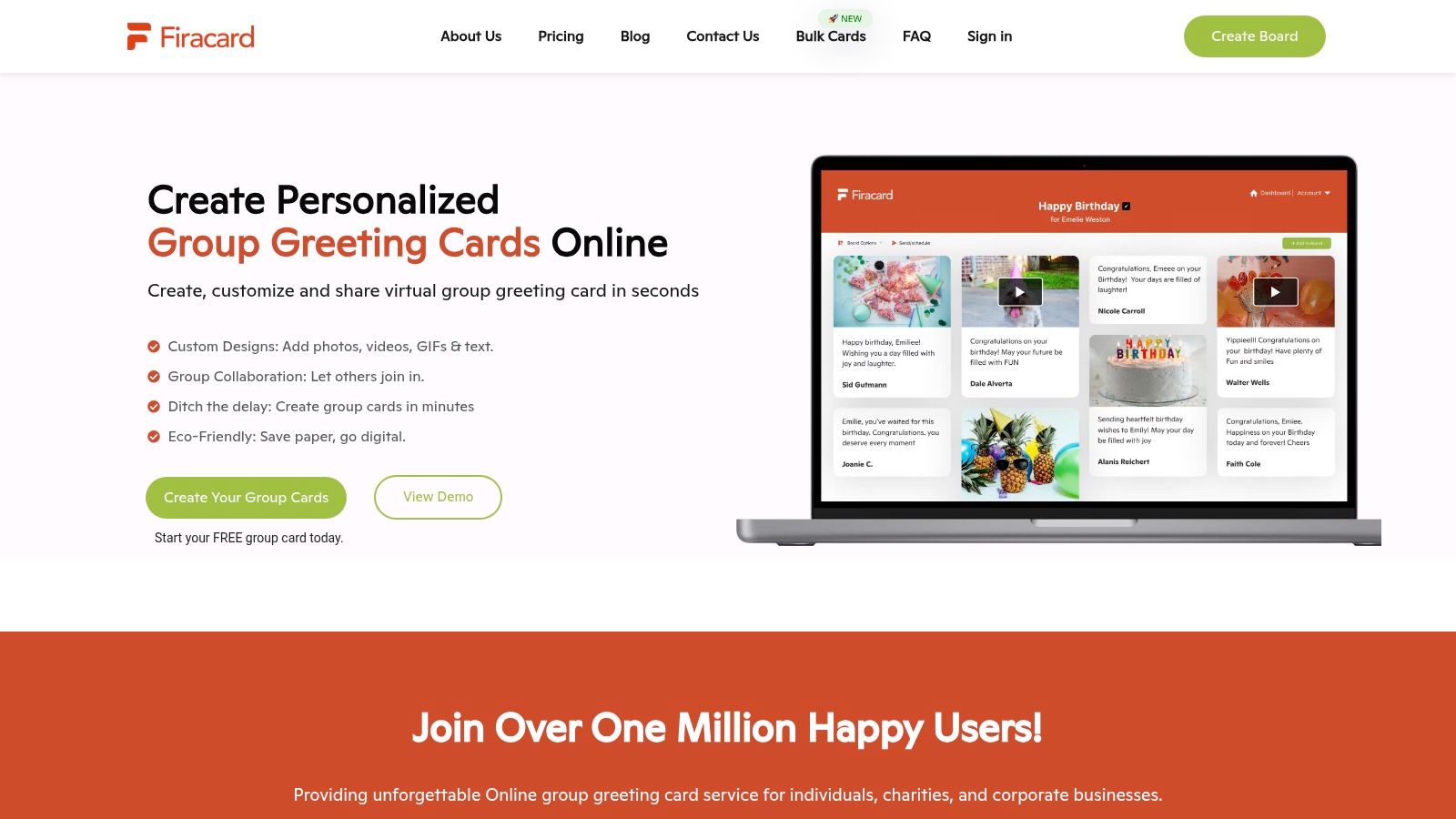
A small team may start with the Free plan when the contributor group is limited. A larger department may need Premium for multimedia, scheduling, multiple recipients, and export options. Infinity suits organisations that don't want to manage a contributor ceiling across large campaigns.
The platform also offers bulk bundles starting at $1.50 per card, according to the product information supplied for this service. Confirm the applicable currency, VAT treatment, bundle terms, and account conditions before placing a UK purchase, particularly if finance requires a purchase order or VAT-compliant invoice.
The UK market supports the case for a digital channel without implying that online has replaced physical cards. Moonpig Group reports that in 2023, online transactions represented 15% of UK greeting-card market value and 6% of volume, while 37% of UK adults had bought at least one card online, according to its UK greeting-card market overview. That leaves most activity offline, but it also shows a substantial audience already comfortable with online card buying.
For an organisation comparing formats, a review of bulk group greeting cards for teams can help frame the choice around contributor access, scheduling, recipient experience, and total administration rather than sticker price alone. Recipients can also download a high-resolution keepsake or PDF, giving the message a longer life than a single delivery event.
Digital bulk cards solve a coordination problem as much as a pricing problem. A single board can collect contributions from colleagues in the UK, United States, Australia, Canada, India, and Africa without moving a physical object between desks or offices. That makes the process easier to organise across time zones and reduces the risk that remote workers are treated as an afterthought.
The financial case depends on the supplier's rules, but the operational case is clearer. Digital delivery removes physical postage and storage, while scheduled sending helps organisers work ahead of a leaver's final day or a birthday. Contributors can add personal messages and media through one link instead of passing a card through a chain of employees.
A good team card shouldn't disappear after the email arrives. Downloadable files, high-resolution versions, and PDFs give the recipient a lasting keepsake. Password protection and entry management also help organisers control who contributes and keep the final message appropriate.
Digital formats can support environmental goals by reducing paper and physical delivery, although buyers should still assess the provider's own service model and data policies. Firacard's paid-card model also supports tree planting through its partnership with One Tree Planted, according to the publisher's product information.
The wider online market remains under pressure. IBISWorld estimates that UK online greeting-card retailers will have a market size of £338.7 million in 2026, with the category declining at a 1.9% CAGR between 2021 and 2026. Separately, Salience reports that the UK greeting-card market declined 21.00% from July 2025 to July 2026 in its 2026 Greeting Cards Industry Report. Those figures strengthen the case for retention-focused team programmes, but they don't remove the need to verify pricing and value for your organisation.
Use this guide to digital cards for work to turn occasional celebrations into a controlled recognition workflow. Start with one department, define the approval route, measure administration time qualitatively, and expand only when the process works.
Firacard provides collaborative group greeting cards, shareable contribution links, scheduled delivery, downloadable keepsakes, and plans that scale from small teams to unlimited contributors. Visit Firacard to start with a free board or discuss a bulk arrangement that fits your organisation's card programme.


Finding the right words for a 50th birthday can feel oddly difficult. You want to honour a major milestone without making the message sound like a
You've just heard that someone you care about has lost a parent. The funeral is approaching, friends are scattered across cities, and nobody w
You can have hundreds of friendly contacts and still feel unsure who would answer when life gets messy, so what makes a friendship good, and how ca