50th Birthday Wishes: 8 Meaningful Templates
Finding the right words for a 50th birthday can feel oddly difficult. You want to honour a major milestone without making the message sound like a


Sep 19, 2026 | 19 Min Read

Make Their Retirement Goodbye Personal
You've got the card open, the retirement date is close, and the blank space is suddenly much harder to fill than it should be. People don't struggle because they care too little. They struggle because “Happy retirement” feels too thin for someone who has shaped a team, mentored colleagues, or made work better for years. That gets even harder when messages are coming in from different people, time zones, and relationships.
The strongest emotional retirement messages usually do two things well. They choose a clear emotional direction, then ground it in specific memories. That's what stops a farewell from sounding generic. It also matters more than many teams realise. In the UK, the average retirement age is 66, and about 11 million people aged 65+ make up roughly 16% of the population, according to Audley Villages' UK retirement statistics. Retirement isn't a niche moment. It's a major life transition.
That's why a thoughtful online leaving card or group message board can carry real weight, especially when people are contributing remotely. If you're collecting notes, photos, GIFs, or short videos from a wider circle, Firacard is one option for turning those contributions into a shared keepsake rather than a rushed sign-off. And if you're pairing a card with a present, ideas like luxury gifts for men NYC can help round out the gesture.
Below are eight retirement message templates organised by emotional purpose, with ready-to-adapt wording and practical guidance for a group greeting card, virtual leaving card, digital leaving card, or personalised ecard.

When someone leaves behind a clear legacy, broad praise isn't enough. The best version of this message names what they built, who they helped, and what people will keep carrying forward because of them.
This works especially well in a group online card because different contributors can each add one concrete example. One colleague might mention a project rescue. Another might mention calm leadership during a difficult period. A third might mention how the retiree set the tone for kindness or rigour.
Try a structure like this:
“Thank you for everything you've given to this team. Your work didn't just move projects forward. It shaped people, standards, and the culture around you. I'll always remember [specific memory or contribution]. Your legacy will stay with us long after your final day.”
For a manager, make it more organisational. For a peer, make it more personal. For a family-led business or charity, mention community impact as well as job impact.
A practical example: a people team might invite contributors with one prompt only, “What is one thing this person changed for the better?” That produces stronger material than “Write a retirement note.”
Recognition matters in the UK workplace. Reward Gateway | Edenred's 2025 Appreciation Index reported that British employees had the lowest appreciation score in its comparison set at 61.8 out of 100, while 88% said they work harder when appreciated, 91% reported higher engagement, and 92% reported higher job satisfaction in this coverage of the Appreciation Index. A retirement card is a farewell, but it's also a recognition moment.
If you need help shaping the wording, Firacard's guide on what to write in a retirement card is a useful starting point.
Some retirees don't want a solemn send-off. They want energy, optimism, and a sense that the next chapter is still theirs to define. This template fits that mood.
It's especially good for a bright virtual leaving card with emojis, photos, travel references, hobby ideas, or cheerful predictions from colleagues. The tone should feel warm, not patronising. You're celebrating freedom, not implying they've stepped out of relevance.
A simple version looks like this:
“Congratulations on your retirement. I'm so excited for everything ahead of you, from the quiet mornings to the big adventures. You've earned the chance to spend your time your way, and I hope this next chapter brings you joy, rest, and a few wonderful surprises.”
You can sharpen that by adding one future-facing detail. If they love gardening, mention the garden. If they've talked about travelling, mention the places. If they plan to keep consulting, volunteering, or studying, honour that too.
Flying Flowers recommends making retirement messages personal, including shared memories, being slightly cheeky if it suits the relationship, and focusing on the adventures ahead in its retirement message guide. That advice works because upbeat cards become more believable when they include one real detail instead of generic excitement.
A good forward-looking message doesn't tell the retiree what retirement should look like. It gives them room to define it for themselves.
If you want prompts for that future-facing tone, Firacard's article on exploring new hobbies and interests in retirement can help contributors move beyond “enjoy the golf.”

This is one of the strongest emotional retirement messages for leaders, teachers, specialists, and long-serving managers. People may forget a title quickly. They don't forget who taught them how to think, work, and handle pressure.
The wording should focus less on “we'll miss you” and more on “here's what you leave in us.” That gives the retiree something concrete to carry with them. It also helps junior contributors write meaningful notes without overreaching.
Use language like this:
“Thank you for the knowledge, patience, and confidence you shared so generously. I've learned so much from you, especially [specific lesson, habit, or piece of advice]. Your influence will keep showing up in my work long after your retirement begins.”
That message can come from one person, or you can gather many short versions into a group greeting card. In schools, universities, healthcare teams, and technical departments, this often becomes the most moving format because contributors can point to skills and standards they still use every day.
The invitation matters. Don't ask, “Would you like to leave a message?” Ask, “What did they teach you that you'll carry throughout your career?” You'll get better stories.
The design matters too. A review of reward and recognition literature hosted by the NHS states that recognition improves staff engagement, job satisfaction, productivity, and organisational commitment, and recommends making recognition personal, immediate, and tied to specific behaviour. The same review notes that recognition programmes can lift engagement by as much as 40% in the NHS reward and recognition literature review. That's a strong argument for detailed, specific retirement tributes rather than bland sign-offs.
If someone is also giving a speech, Firacard's guide to writing a memorable retirement speech for a colleague pairs well with this message style.
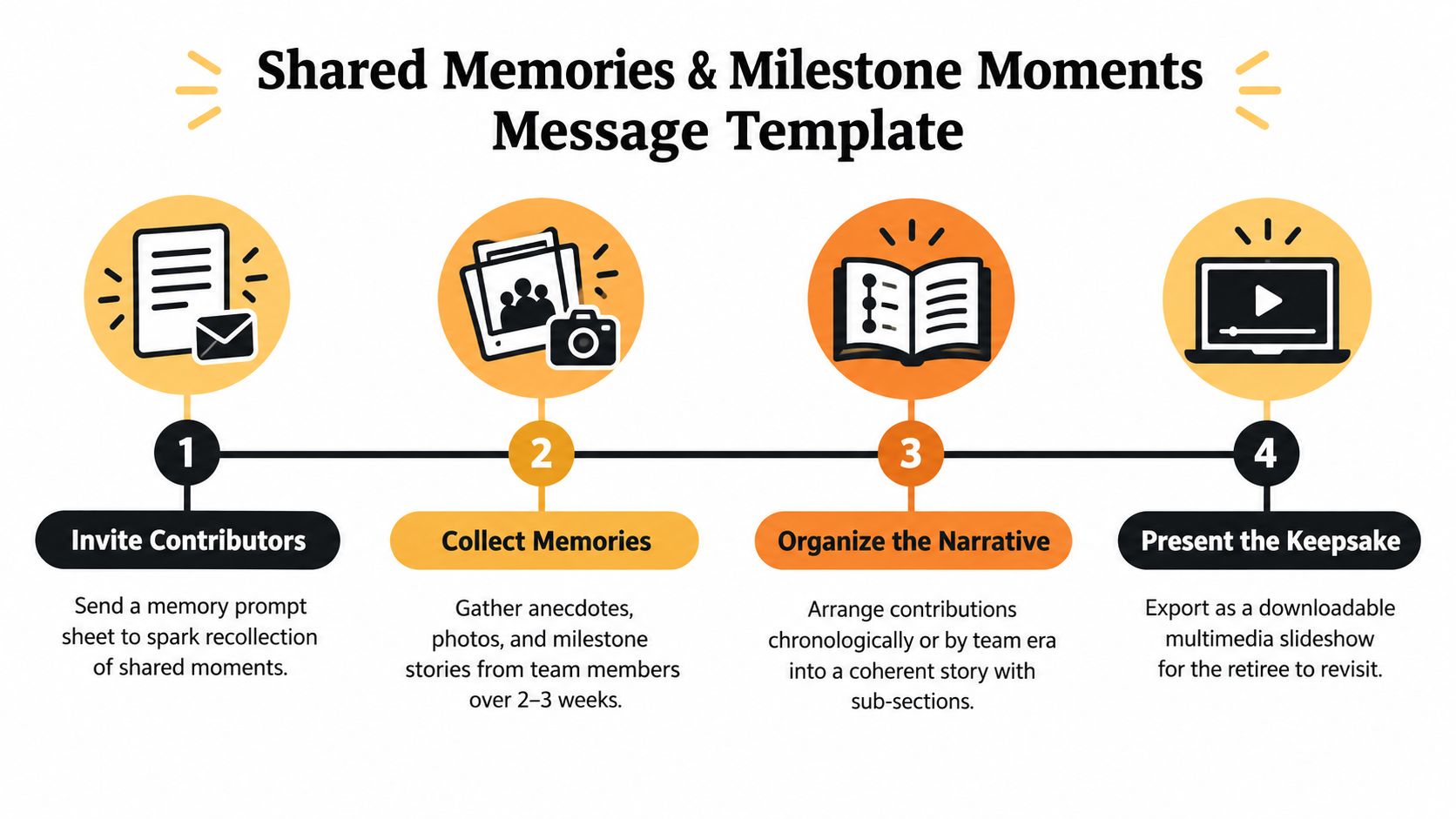
Retirement messages become memorable when they read like lived history instead of summary. This template works by collecting moments, not adjectives.
Think of it as a chaptered keepsake. One group writes about the early years. Another writes about major projects. Another adds office traditions, funny incidents, and milestone wins. The result feels fuller than a standard digital leaving card because it recreates a shared world.
Start with a framing note from someone close to the retiree. Then arrange contributions by era, team, or theme. Photos help, but captions matter just as much because they explain why the moment belongs.
Adobe Express suggests a practical structure for farewell cards that includes acknowledging the departure, adding a shared memory, expressing appreciation, and closing with positive encouragement in its goodbye card guide. That sequence is useful because it stops memory-based messages from becoming rambling anecdotes.
Here's a useful pattern for contributors:
A memory-driven card is one place where images and video earn their place. A slideshow of project photos, event snapshots, or handwritten notes can turn a standard ecard into something worth revisiting.
If you want to embed that feeling into a keepsake, this is a strong format to borrow from:
Firacard also has a guide on creating heartfelt collaborative video slideshows that fits this memory-led style well.
Some retirements call for more than listing achievements. They call for naming the person's character. Not what they delivered, but how they made people feel while delivering it.
This template works well when the retiree is known for kindness, steadiness, integrity, calm leadership, or courage. In those cases, specific stories of values in action are far more powerful than a polished summary of responsibilities.
Try this approach:
“Your retirement marks the end of an important chapter for this organisation, but what I'll remember most is who you were every day. Your kindness, integrity, and steady support shaped the people around you just as much as your work did. Thank you for showing what good leadership and good character look like.”
This style often benefits from themed sections inside a group greeting card. You might group contributions under “Kindness”, “Integrity”, “Courage”, or “Humour” so the retiree sees a pattern emerge across many voices.
Recent UK research commissioned by M&G found that 58% of people think the way retirement is written, talked about, or portrayed is uninspiring, 55% say it doesn't reflect the life they want to lead, and 72% believe retirement needs to be portrayed in a more accessible way, as referenced in SunLife's what to write in a retirement card article. Character-based messages help because they move beyond stale retirement clichés.
Practical rule: If you praise a value, attach a moment to it. “You were kind” is pleasant. “You stayed late to help new starters settle in during their first chaotic week” is memorable.
For broader send-offs in schools, charities, and value-led organisations, Firacard's post on workplace retirement celebration ideas can help shape the wider moment around the card.
Humour works brilliantly when the relationship can carry it. It fails fast when the card includes mixed audiences, uncertain boundaries, or jokes that need too much explanation.
The safest version of a funny retirement message doesn't punch down and doesn't rely on stereotypes about age, money, or health. It plays with familiar habits, recurring one-liners, office rituals, or affectionate predictions about what the retiree will do with all that reclaimed time.
A balanced example:
“Happy retirement. We're all thrilled for you, even if we're slightly concerned about what will happen now that you no longer have meetings to attend, people to organise, or anyone to politely correct. We'll miss your [specific habit, joke, or ritual] almost as much as we'll miss having you around.”
That works well in an ecard or digital leaving card where contributors can add GIFs, playful captions, and photos with context. It also works for a sorry for leaving card when the mood is more “we can't believe you're going” than formal tribute.
Funny cards usually get more participation because they feel easier to write. But they need firmer editing. A single awkward joke can sour the whole thing, especially if senior leaders, family members, or external partners will read it.
Age UK's 2024 parliamentary briefing said 7% of people aged 65+ in the UK often or always feel lonely, equivalent to about 930,000 people in Age UK's loneliness briefing. That's a useful reminder that humour should connect, not isolate. A joke-filled retirement card should still leave the recipient feeling included, seen, and wanted.
A retirement card often stalls for one simple reason. People want to say something meaningful, but they do not have time to write a full tribute. Gratitude solves that problem.
This template works best when you need broad participation across different relationships, seniority levels, or writing styles. It gives occasional collaborators, direct reports, peers, and leaders a clear lane. Each person can thank the retiree for one concrete thing, and the finished card builds emotional weight through many small contributions.
Use wording like this:
“Thank you for the support, care, and commitment you brought to this place. I'm grateful for the way you helped me with [specific situation], and I'll remember your [quality or habit] with real appreciation. Wishing you a happy and fulfilling retirement.”
That structure is easy to adapt. A direct report might thank them for patience and guidance. A peer might mention reliability during a difficult project. A senior leader might keep it broader and focus on contribution, steadiness, and trust.
Gratitude is easier to gather than grand sentiment, especially in collaborative digital cards. One note may read as modest. Thirty short notes from different people can feel substantial because they show range. The retiree sees not just affection, but evidence of impact across the group.
That also makes this one of the safer formats for mixed workplace cultures. In a formal organisation, the tone stays respectful. In a close-knit team, contributors can still sound warm and personal. The trade-off is that vague thanks can blur together, so editing matters more than people expect.
Short thank-you notes work best when each person answers one question: what are you grateful to this person for?
For larger groups, keep the brief simple:
That process usually gets more responses than asking for long reflections. It also helps a collaborative card feel coherent without sanding off each person's voice.
If your team also marks other milestones, the same process can work for a birthday ecard or another personalised card for future occasions.

Not every retirement feels purely celebratory. Sometimes the honest tone is mixed. People are happy for the retiree and sad to lose them. This template works because it doesn't force a false mood.
That balance suits senior leaders, long-tenured colleagues, teachers, founders, and anyone whose departure changes the emotional shape of a place. It also suits contributors who want to be sincere without sounding gloomy.
Try this:
This goodbye is a bittersweet one. We're so happy for you as you step into a new chapter, and at the same time, it's hard to imagine this place without you. Thank you for everything you've given, for the example you've set, and for the way you've shaped our days. We'll miss you, and we're cheering you on just as strongly.
That language feels human because it allows both truths. You can then add one memory, one quality, and one hopeful wish.
Standard Life's Retirement Voice 2025 found that 47% of people aged 55 to 65 had talked to family or friends about pensions in the last 12 months, while 24% did not use any source for retirement planning information, as cited in Cosmopolitan's farewell messages to colleague article. Retirement often isn't a neat finish line. It can be emotionally loaded, practical, uncertain, and exciting all at once.
That's why some of the best emotional retirement messages acknowledge complexity. Don't mention finances or private worries directly unless the retiree has done so openly. But do allow room for mixed feelings, continued friendship, and future contact.
The most believable bittersweet messages end with connection. “Please stay in touch” is often more comforting than another line of praise.
| Template | Implementation complexity | Resource requirements | Expected outcomes | Ideal use cases | Key advantages |
|---|---|---|---|---|---|
| The Heartfelt Gratitude & Legacy Message Template | Medium–High, coordination and editorial review | Multiple contributors, time for thoughtful entries, multimedia support (Premium/Infinity) | Deep, narrative legacy keepsake with emotional storytelling | Virtual leaving cards; large group cards (10–100+); remote/hybrid teams | Encourages specific memories, strong emotional resonance, multimedia preservation |
| The Warm Wishes & New Adventures Message Template | Low–Medium, simple structure with upbeat prompts | Basic contributor input, optional media; works on all plans | Uplifting, future-focused messages that celebrate possibilities | eCards, multi-generational teams, celebratory send-offs | Positive tone, highly shareable, broad appeal across audiences |
| The Mentorship & Knowledge Transfer Message Template | High, requires thematic organization and thoughtful reflection | Time for mentee testimonials, video/audio options, Premium/Infinity recommended | Powerful record of mentorship and practical knowledge transfer | Retiring leaders, educators, mentoring-focused organizations | Highlights teaching impact, promotes pay-it-forward pledges, preserves wisdom |
| The Shared Memories & Milestone Moments Message Template | High, chronological curation and fact-checking needed | Photo/video gallery, memory prompts, editorial organization, Premium/Infinity | Nostalgic narrative keepsake that strengthens team bonds | Teams with long shared history; large organizational retirements | Specific anecdotes and milestones, multimedia slideshow, entertaining to revisit |
| The Values & Character Affirmation Message Template | Medium, needs curated prompts and thematic sections | Diverse contributor voices, themed organization; benefits from Premium features | Deep emotional affirmation that reinforces culture and identity | Values-driven organizations, culture-focused leaders | Honors character over achievements, models values-based recognition |
| The Humor & Inside Jokes Message Template | Low–Medium, requires tone moderation and editing | Casual inputs, GIFs/photos encouraged, works on all plans | Joyful, entertaining keepsake; risk-managed humor | Casual workplace cultures, tight-knit teams, informal send-offs | Fun and shareable, builds camaraderie, lightens the occasion |
| The Gratitude & Thank You You Message Template | Low, straightforward prompts and minimal editing | Minimal time per contributor, simple prompts, works on all plans | Sincere, high-participation collection of thank-you notes | Any retirement scenario where authenticity is priority | Easy to write, universally appropriate, high completion rates |
| The Bittersweet Transition & New Chapter Message Template | Medium–High, needs editorial balance and guided tone | Thoughtful contributors, multimedia optional, Premium/Infinity preferred | Nuanced keepsake that honors loss and celebrates new beginnings | Long-tenured retirees, emotionally sophisticated organizations | Emotionally honest, models healthy expression, ages well over time |
The best retirement message isn't the most poetic one. It's the one that fits the person. If the retiree is widely admired across the organisation, go with gratitude and legacy. If they changed people's careers, choose mentorship. If the team shares years of stories, build the card around memories. If the culture is close and playful, humour can work beautifully. If the departure feels emotionally complex, use bittersweet language and let the message hold both loss and joy.
That choice matters because retirement isn't only ceremonial. Older adults can face real risks of disconnection, and UK loneliness data gives that context sharp edges. The Office for National Statistics reported in 2015 that people aged 80 and over had a loneliness rating of 3.3 out of 10, compared with 2.1 for the working-age population and 1.9 for those aged 65 to 79. It also found that 29.2% of those aged 80+ reported feeling lonely, versus 14.8% of working-age adults and 14.5% of those aged 65 to 79, while people living on their own were more than twice as likely to report loneliness at 30.8% compared with 12.6% for those not living alone in Age UK's loneliness report. A thoughtful farewell won't solve that on its own, but it can strengthen a sense of belonging at exactly the right moment.
For personalisation, keep the formula simple:
For group cards, the workflow should stay tight. Choose a farewell design. Send one focused prompt to contributors. Set a deadline that gives you time to review entries for warmth, tone, and privacy. Add optional media such as photos, GIFs, or short videos. Then send or schedule the finished online leaving card through Firacard's farewell card collection or organise a larger recognition moment with Firacard bulk group greeting cards.
If you're also planning a physical tribute, plaque wording for lasting tribute can help you carry the same emotional tone into a more permanent format.
A retirement card doesn't need grand language. It needs honest language, well chosen, well timed, and made personal by the people who mattered.
Firacard gives teams, schools, families, and organisations a practical way to collect retirement messages in one place, with space for text, photos, GIFs, and video from multiple contributors. If you want to turn scattered goodbyes into a thoughtful keepsake, visit Firacard and build a collaborative card that fits the retiree and the moment.


Finding the right words for a 50th birthday can feel oddly difficult. You want to honour a major milestone without making the message sound like a
You've just heard that someone you care about has lost a parent. The funeral is approaching, friends are scattered across cities, and nobody w
You can have hundreds of friendly contacts and still feel unsure who would answer when life gets messy, so what makes a friendship good, and how ca