50th Birthday Wishes: 8 Meaningful Templates
Finding the right words for a 50th birthday can feel oddly difficult. You want to honour a major milestone without making the message sound like a


Oct 1, 2026 | 18 Min Read

A retirement send-off gets complicated when the retiree's colleagues work in London, Toronto, Sydney, or Bangalore, while family and former teammates live elsewhere. A paper card may sit on one desk, and a hurried email may miss the stories that made the person valued. The strongest happy retirement cards combine specific memories, an appropriate tone, and an easy way for everyone to contribute, wherever they are.
This guide organises eight practical formats by audience and operating context. You'll find ideas for multimedia tributes, corporate programmes, schools, charities, hybrid teams, and families, along with advice on prompts, participation, deadlines, privacy, and delivery. The options include online leaving cards, group greeting cards, virtual leaving cards, and personalised ecards.
The occasion can also sit alongside a celebration planned with budget-friendly party decoration tips. Whether you're coordinating an office farewell or sending a retirement card from a family group, the right structure will make participation easier and the finished keepsake more meaningful.
A London project team may want to include a favourite photo, while colleagues in Toronto and Sydney can contribute from different working hours. A digital group retirement card gives each person space to add a short video, voice message, photograph, or specific memory. The finished card becomes a compact record of the retiree's work and relationships, rather than a page of signatures.
Firacard supports this collaborative format for contributors across the United Kingdom, United States, Australia, Canada, India, and Africa. A software company could invite teammates to contribute without requiring one shared meeting. An international nonprofit could use the same structure to recognise a departing board member whose work reached several regions. The trade-off is coordination: multimedia adds warmth, but it also requires clearer file guidance and review time.

A blank invitation usually produces uneven responses. Give contributors prompts that make specific stories easier to write:
Send the invitation before the final working day, set a closing date, and assign one person to check duplicate photos, unclear messages, and unsuitable files. A high-resolution PDF or slideshow export gives the retiree a keepsake beyond the presentation. Organisers can use this collaborative video slideshow guide to arrange varied contributions into a coherent sequence.
Schedule delivery for the retirement party or final day. Releasing the card only after contributions close protects the surprise and creates one shared moment, while asynchronous collection avoids finding a time that suits every contributor.
A financial services firm with frequent retirements can prepare role-based templates, then adapt each card with the recipient's name, responsibilities, photographs, achievements, and team memories. This approach gives HR or People Operations a repeatable process without making every farewell feel identical.
Government departments can apply the same model across teams. Healthcare organisations can coordinate recognition for retiring nurses, administrators, and senior staff through one programme instead of asking each local office to create its own process. The format also suits employers with several retirements scheduled close together.
Set an operating calendar before invitations go out. Prepare approved visual styles and opening language, appoint one coordinator, and ask each manager for specific context about the retiree. Keep the template focused on administration. Contributors should still have room to write in their own voice.
Use Firacard's bulk group greeting card service when several cards must be launched and scheduled through one recognition programme. The guide to bulk group greeting cards for teams can help teams assign invitation and approval responsibilities.
Practical rule: Keep the design consistent across the programme, but reserve space for one detail that could belong only to that retiree.
Build in time for managers to confirm retirement dates, contributors to respond, and HR to review the final copy. One owner should monitor participation, send reminders, and verify that each recipient receives the correct card. A simple tracking sheet can record the retiree, manager, closing date, reviewer, and delivery schedule.
The trade-off is straightforward. Bulk handling reduces administrative work, while heavy standardisation can make a card feel impersonal. Require a manager's note, a team memory, or a short summary of the retiree's contribution before approval. That small requirement preserves individual recognition while keeping the programme manageable.
The right capacity depends on the retiree's working relationships, not just the department's headcount. A small team may need only a handful of messages, while a supervisor may have worked with colleagues across production, sales, operations, and support.
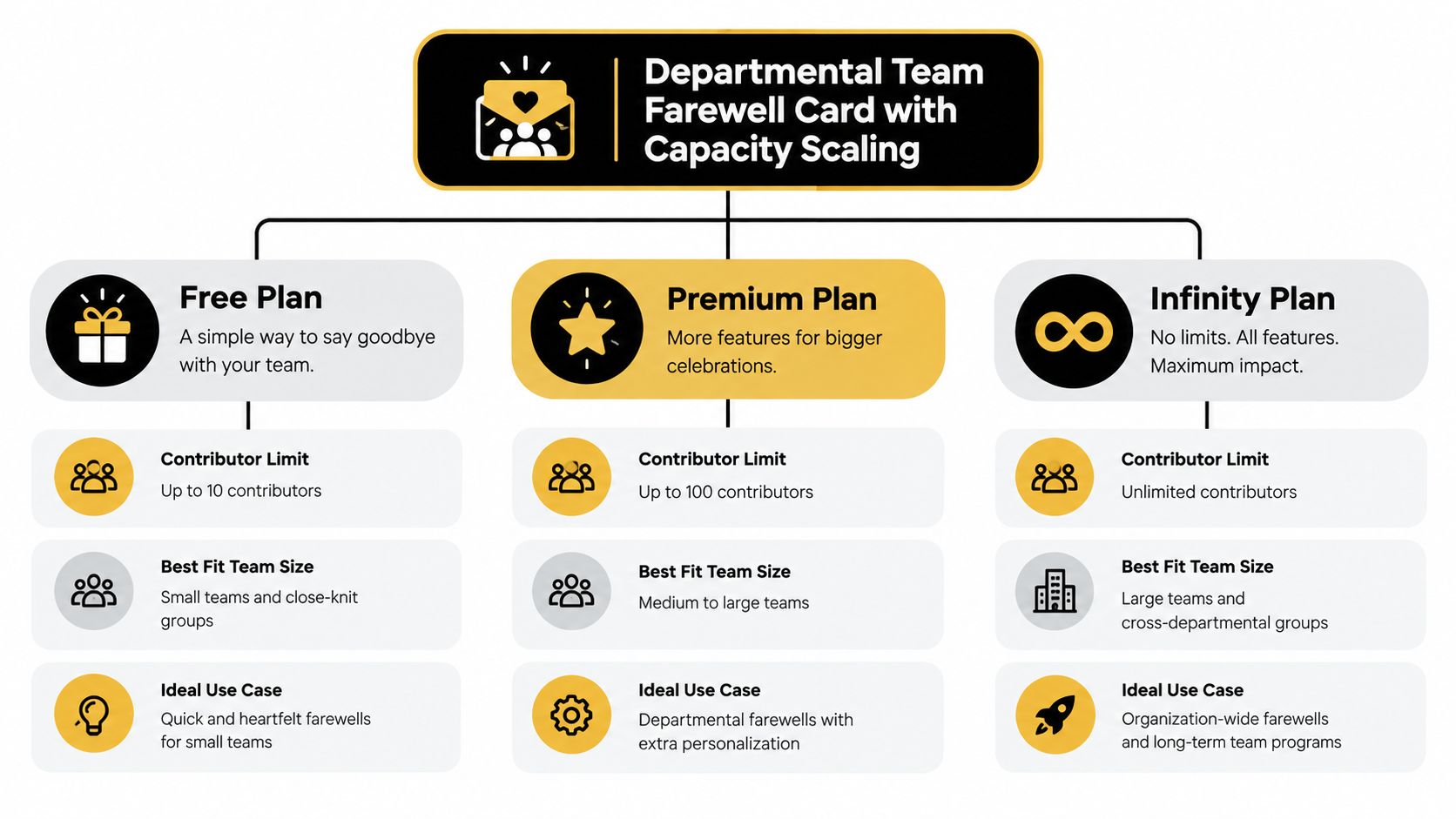
Firacard offers three participation levels. The Free plan supports up to 10 contributors, Premium supports up to 100, and Infinity allows unlimited contributors. These limits help organisers match the card to the audience. Free suits a close department, Premium can accommodate a larger staff group, and Infinity fits a farewell involving several functions or shifts.
A manufacturing facility with 200 employees might select Infinity for a well-liked supervisor whose colleagues work different shifts. A school could move from Free to Premium if a principal's farewell expands beyond the initial teaching team. For a nonprofit, Infinity may suit a founder's retirement when employees, donors, board members, and partners want to contribute.
Use Firacard's group digital greeting card guidance to plan invitations and contributions. Estimate the genuine audience before sharing the card link. A wider group can show the retiree's reach, but without a defined scope, the board may fill with repeated congratulations and low-value remarks.
Capacity is only one design decision. Set the audience first, whether that means one department or the wider organisation. Use password protection if the card should remain within a defined group. Review contributions before the deadline, then export the slideshow early enough for a farewell meeting or presentation.
A large card works best when inclusion has a clear purpose. It does not need every employee if only a smaller group worked closely with the retiree.
The practical trade-off is breadth versus editability. A compact card is easier to curate, while a larger one can show the full reach of the retiree's relationships. If participation grows substantially, organise messages by team or theme. That structure gives the retiree a coherent story instead of a long sequence of similar congratulations.
Remote teams don't have the natural “pass the card around the office” moment. A virtual leaving card replaces that physical route with an asynchronous invitation, allowing people to contribute when their workday permits.
Consider a technology company with engineering teams in San Francisco, London, and Bangalore celebrating a retiring chief technology officer. A consulting firm may need contributions from partners across North America and Europe, while a customer service organisation could be coordinating messages from Australia, India, and the UK. In each case, a single live meeting would exclude someone or make participation inconvenient.
Keep the contribution window open for two to three weeks when the team spans locations. Send reminders at different times, include written instructions that people can access at any hour, and provide a short example of the right level of detail. A video tutorial can help less confident contributors, but it shouldn't replace clear written steps.
The best virtual group greeting card guidance for teams can help organisers design a process that doesn't depend on everyone being online together. Schedule delivery for a meaningful time in the retiree's home location, such as the start of their farewell event or the end of their final working day.
Remote-team insight: Asynchronous doesn't mean slow. People often contribute quickly when the prompt, deadline, and invitation link are unmistakable.
The principal trade-off is immediacy. A live video tribute offers instant reactions, but it can be difficult to coordinate and may favour the loudest participants. A virtual card gives quieter colleagues more time to write something considered, and it leaves the retiree with a durable keepsake rather than a moment that disappears when the call ends.
Schools and universities often have unusually deep retirement stories. A retiring teacher may have taught several generations, while a professor may have shaped students, researchers, alumni, and colleagues over a long academic career. A group greeting card can bring those communities together without forcing every contributor into one event.
A secondary school could invite current pupils, former students, teaching staff, support staff, and parents to celebrate a long-serving teacher. A university might gather messages from current students, alumni from different decades, faculty colleagues, and department staff for a retiring professor. Student organisations can also coordinate a card for a principal or administrator, with student leaders managing the collection.
Younger contributors may need a simple structure, such as “What did this person help you learn?” or “What will you remember about their classroom?” Alumni can add perspective about lasting influence, while colleagues may write about leadership, care, or institutional knowledge.
Launch the campaign early enough to reach people outside the current timetable. Student leaders can promote the card through approved channels, and separate cards by year group or department may be easier to manage than one very large board. Display the finished slideshow at an assembly or retirement gathering, subject to the institution's privacy rules.
The teacher retirement card message guide can support prompts that sound appreciative without becoming repetitive. Avoid asking students to produce polished speeches. A short, specific memory often carries more emotional weight than formal praise.
For schools: Ask for one remembered action, one lesson, or one quality. Those prompts give students a clear starting point and help the final card feel like a collection of real voices.

A formal organisation can make a retirement ecard recognisable without making it impersonal. Set the visual identity, tone, and message framework first, then adapt them for senior leaders, managers, and individual contributors.
A large company might create branded ecards for separate business units. A professional services firm could use one design for partner retirements and another for wider staff recognition. A bank may reflect stewardship, service, or long-term trust in the wording, provided the card still feels like a farewell rather than a corporate announcement.
Branding should support the person's story, not dominate it. Before inviting contributions, write a short guide covering the preferred tone, phrases to avoid, and whether humour suits the recipient. An executive card may require more formal wording than a close team's version, while both should include a specific personal detail.
Use a simple design system:
The operating trade-off is polish versus spontaneity. Strong branding looks organised, but excessive corporate language makes the card resemble an internal memo. Keep identity elements restrained, and let contributors write in their own voice. If the organisation archives cards for internal communications, obtain permission before reusing photographs or messages.
Retirement in a charity isn't always about leaving a conventional job. A long-serving volunteer, trustee, board member, or executive director may be stepping away after years of service, while the organisation and its beneficiaries continue to feel the impact.
An animal rescue organisation could collect messages from staff, donors, volunteers, and adopters whose animals benefited from the retiree's work. A youth mentoring charity might invite former mentees, programme coordinators, and fellow volunteers to recognise a mentor. An international development organisation could include messages from global staff, community partners, and supporters for a retiring director.
A request for “a few kind words” often produces generic praise. Instead, ask people to describe a specific change the retiree helped create, a moment when they offered support, or a lesson that will remain in the organisation. Beneficiaries may need a simpler prompt than donors or trustees, so tailor the request to the audience.
Promote the campaign through existing volunteer communication channels and connect it to the organisation's mission. The finished slideshow could be shown at a gala, volunteer recognition evening, or final programme event. A written or video archive can also preserve institutional memory, provided contributors consent to its future use.
Charities reviewing their wider operations may also find relevant volunteer management tools, particularly when the same people coordinate campaigns, events, and recognition.
A meaningful charity farewell names the people helped, the work strengthened, and the values the retiree leaves behind.
Firacard's paid cards support tree planting through its partnership with One Tree Planted, which may align with an organisation's environmental priorities. Still, sustainability should support the message rather than replace it. The strongest card remains the one that tells the retiree exactly why their service mattered.
A team that already coordinates annual birthday greetings can adapt the same process for retirement recognition. The workflow may be familiar, but the purpose changes. Retirement marks the end of a career chapter and the beginning of a different routine, so the card needs more thought than a recurring birthday message.
HR can add retirement events to the employee recognition calendar and begin planning early. That gives managers time to confirm contributors, collect meaningful messages, and choose a delivery date that fits the person's final week. Families can use a shared birthday ecard habit in a similar way when celebrating a parent or grandparent's retirement.
Rename the card with a clear heading such as “Celebrate [Name]’s Retirement.” Tell contributors what they are creating, then ask for material suited to the occasion: a work memory, a specific contribution, or a wish for the retiree's next stage. Humour can work when it reflects the person's character, but the overall tone should recognise the significance of the transition.
A birthday ecard workflow provides a practical starting point. Change the design, prompts, contributor list, and delivery schedule rather than copying the birthday campaign unchanged. Larger groups may need Premium or Infinity capacity, while a small family or team can keep the setup simple. Maintain separate guidance for birthday and retirement campaigns so contributors do not submit routine greetings.
Use three prompts to keep messages specific:
The operating trade-off is administrative efficiency versus a distinct experience. Reusing the workflow saves coordination time, while a generic birthday layout can make retirement feel like an afterthought. Change the visual treatment and prompts enough to signal a major milestone, then schedule delivery for the farewell gathering or the retiree's final working day.
| Solution | Implementation complexity | Resource requirements | Expected outcomes | Ideal use cases | Key advantages |
|---|---|---|---|---|---|
| Digital Group Retirement Card with Multimedia Contributions | Medium, uses existing platform with multimedia support | Contributors need devices, internet, basic digital literacy; minor admin time | Rich multimedia keepsake exportable as PDF/slideshow; high inclusivity | Remote and hybrid teams across continents | Multimedia richness, global participation, eco-friendly, downloadable keepsake |
| Bulk Corporate Retirement Ecard Programs | High, enterprise setup, templates, admin workflows | Higher upfront investment, coordinator(s), template and analytics setup | Scalable, consistent recognition across many retirees; lower cost per card | Large organizations with many annual retirements | Bulk pricing, consistent branding, admin dashboard and analytics |
| Departmental Team Farewell Card with Capacity Scaling | Low–Medium, select plan and manage contributors | Variable (Free to Infinity); may require plan upgrades and admin oversight | Inclusive departmental cards with scalable contributor capacity | Departments, cross-functional teams, medium-to-large groups | Flexible pricing tiers, predictable costs, options up to unlimited contributors |
| Virtual Leaving Card for Remote and Hybrid Teams | Low, asynchronous model with shareable links and reminders | Minimal tech; focus on communication across time zones and reminder scheduling | Higher participation from distributed contributors; accommodates time differences | Distributed workforces spanning multiple time zones | Eliminates real-time coordination, mobile-first, automatic reminders |
| Educational Institution Retirement Recognition with Student Integration | Medium, coordination across students, faculty, alumni | Administrative oversight, integration with school channels, age-appropriate controls | Multi-generational keepsake that captures legacy and institutional memory | Schools, universities, alumni and parent communities | Cross-community participation, yearbook-style gallery, strengthens institutional bonds |
| Personalized Ecard with Custom Branding and Messaging | High, design, approvals, and branding integration required | Design resources, branding approvals, higher cost and setup time | Professional branded presentation consistent with corporate identity | Formal corporate settings, executive or high-profile retirements | Reinforces brand, polished exports, branded invitations and PDFs |
| Nonprofit and Charity Appreciation Campaign for Long-Serving Volunteers | Medium, multi-stakeholder coordination and mission framing | Coordination with volunteers/donors, modest budgets, use of volunteer channels | Strengthened donor/volunteer engagement and documented legacy of service | Nonprofits, charities, volunteer organizations | Mission-aligned recognition, affordable, supports environmental partnership |
| Birthday Ecard Transition to Retirement Milestone Celebration | Low, reuse existing birthday templates with minor adjustments | Minimal if platform already in use; small customization effort | Familiar contributor experience and cost-effective milestone recognition | Organizations already using birthday ecards wanting retirement options | Low-friction adoption, leverages existing workflows and contributor familiarity |
The best format depends on who needs to participate and what the retiree will value later. Choose asynchronous multimedia contributions when colleagues are distributed across time zones. Use a scaled group card when a department, school, or organisation has a broad network to include. Choose branded templates for formal recognition programmes, and use guided prompts when schools, charities, friends, or family members need help turning goodwill into specific memories.
Retirement is a widely shared transition in the UK. The State Pension age for both men and women rose to 66 in October 2020, creating a common milestone around which many retirement celebrations are organised, according to UK government later-life planning data. The same survey found that 24% of people aged 40 to 75 were fully retired, 10% were semi-retired, and the median expected retirement age among those not yet retired was 66. It also found that 72% expected to retire later than their ideal age, while 44% expected to retire before State Pension age. That mix explains why the wording should not assume every retiree is stopping work on one fixed date.
The audience may include someone entering phased retirement, working part-time, or planning a different financial route. Use language such as “the next chapter” or “more time for what matters” when the person's work status isn't completely clear. Celebrate the transition without making assumptions about finances, health, or how much work they may continue doing.
A straightforward workflow keeps the project manageable:
The UK greeting-card market gives these occasions a substantial commercial context. The singles greetings-card segment is worth about £1.4bn, according to Moonpig Group's market presentation. Retirement cards sit within that wider market, but their value comes from timing and specificity. A short note about a particular project or kindness can matter more than an elaborate design.
Format also deserves a deliberate decision. A physical card may suit a small office or family gathering where people can sign it together. A digital group card works well for hybrid teams, international organisations, and contributors who need to add content remotely. Firacard's online group cards can be shared by link, personalised with text and media, and delivered on a schedule. Paid cards also support tree planting through One Tree Planted, which gives organisers an environmental consideration alongside convenience.
Before opening the board, prepare prompts that make the finished card personal:
These prompts work for a colleague, teacher, volunteer, manager, parent, or grandparent. They also prevent the most common failure in group cards, a long list of names with no meaningful message attached. A well-run personalized ecard gives everyone an easy way to contribute while preserving the details that made the retiree's career and relationships distinctive.
Firacard offers collaborative online leaving cards, bulk group greeting cards, multimedia contributions, scheduled delivery, and personalised ecards for retirement celebrations. Visit Firacard to create a card that brings colleagues, friends, or family members together and turns their messages into a lasting keepsake.


Finding the right words for a 50th birthday can feel oddly difficult. You want to honour a major milestone without making the message sound like a
You've just heard that someone you care about has lost a parent. The funeral is approaching, friends are scattered across cities, and nobody w
You can have hundreds of friendly contacts and still feel unsure who would answer when life gets messy, so what makes a friendship good, and how ca