50th Birthday Wishes: 8 Meaningful Templates
Finding the right words for a 50th birthday can feel oddly difficult. You want to honour a major milestone without making the message sound like a


Sep 14, 2026 | 15 Min Read
A digital card is a collaborative, multimedia-rich online board where multiple people can add messages, photos, and videos for one recipient. In the UK, online card sales were worth about £212 million in 2023, and the format has become an established way to create and send personalised greetings remotely.
You know the moment. A colleague is leaving on Friday, someone places a paper card beside the office kettle, and the first reminder goes out before lunch. By Wednesday, half the team still hasn't signed it. Remote colleagues never see it, international team members are asleep when it circulates, and the recipient receives a card with a few rushed names instead of the thoughtful messages everyone intended to write.
A digital card removes that bottleneck. It gives a distributed team one shared place to contribute, whether people are working from London, Toronto, Sydney, New York, Mumbai, or elsewhere across the UK, United States, Australia, Canada, India, and Africa. The card can collect personal notes asynchronously, support photos, GIFs, and videos, and arrive instantly or at a planned time.
That makes it more than an electronic picture. For a modern workplace, a well-designed group greeting card acts as a small but useful piece of team culture infrastructure. It helps people mark birthdays, farewells, promotions, thank-you moments, and personal milestones without requiring everyone to be in the same room.
At 9.15 on Monday morning, an office manager starts a leaving card for a departing colleague. By midday, three people have signed it. One is in a client meeting, another works from home, and a third is travelling between offices. The card moves to a new desk, then disappears under paperwork. On Friday, the organiser has to choose between delaying the farewell and sending an unfinished card.
A remote team faces the same problem without even having a physical card to pass around. Someone creates a document, posts a message in a chat channel, and sends several reminders. Colleagues contribute at different times, often in different systems, while the organiser tries to assemble everything before the deadline.
A digital card changes the unit of organisation. Instead of one paper object moving from person to person, the team receives one online board through a shareable link. Each contributor can add a message when it suits them. Depending on the platform, they might also attach a photo, GIF, short video, signature, or personal memory.
A basic ecard might be a designed image or animated greeting sent by one person. A collaborative card is broader. It brings several contributors into the same online experience and gives the recipient a collection of voices rather than a single prepared message.
That distinction matters for workplace recognition:
Practical rule: If the occasion involves several people, choose a format that lets people contribute independently rather than asking one organiser to write on everyone's behalf.
A digital leaving card at work works especially well when a team has a mixture of office-based, hybrid, and fully remote colleagues. It doesn't attempt to erase the familiar ritual of signing a card. It preserves the ritual while removing the physical handover that makes participation unreliable.
The result feels more personal because people can write in their own time. A colleague in a different time zone can add a considered message after work, while someone who dislikes public speaking can record a private contribution instead of being put on the spot during a video call.
The idea didn't begin with remote work software. The UK online greeting-card market started changing earlier, when Moonpig describes its launch in April 2000 as the arrival of the UK's first online card retailer. That model combined digital printing with the internet, allowing customers to create and send personalised cards remotely, rather than choosing only from products available in a shop. Moonpig's account of its online card journey places digital card creation within a longer shift from purely physical products to digitally assembled and distributed greetings.
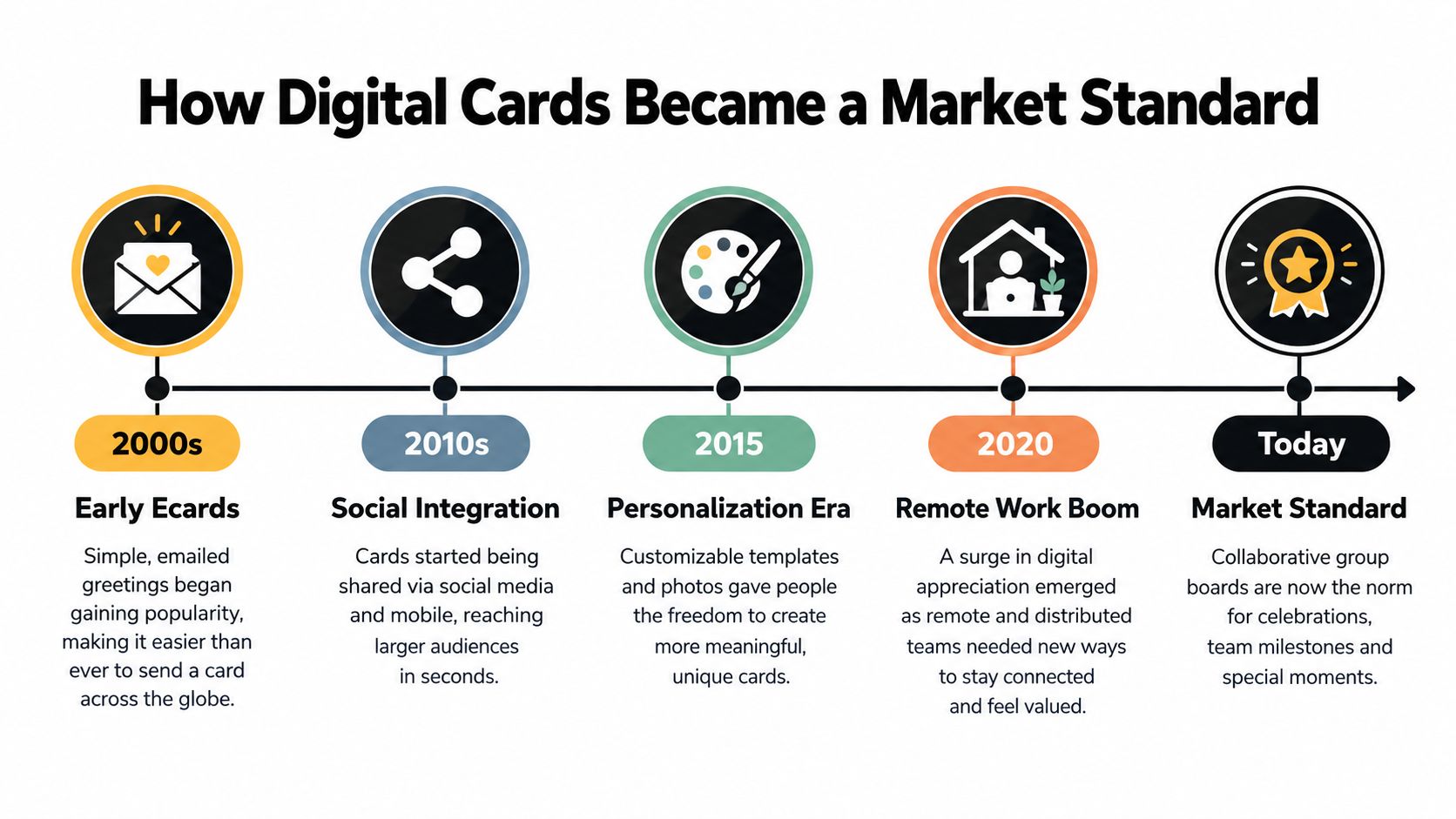
The format has since expanded from personalised print orders and simple emailed greetings into interactive online experiences. People now expect a card to work across devices, support different types of media, and fit the way they already communicate. The technology changed, but the underlying purpose stayed familiar, helping people express care when distance or logistics get in the way.
The available figures show that online cards are commercially significant. Moonpig's investor materials put online card sales at about £212 million in 2023, approximately 7% higher than in 2022, with the online channel representing around 6.7% of the singles greeting-card market by value. The same material describes the UK online cards market as roughly 50% larger in value than before Covid, suggesting that digital ordering became embedded rather than remaining a temporary response to restrictions.
Card Factory's 2025 investor report gives a wider view of the category. It says the UK greeting-card market reached £1.58 billion in 2025, while 21% of purchases were made online. That figure includes online purchases where the final product may still be physical, but it still shows why digital-first discovery, ordering, personalisation, and delivery matter to the sector. Card Factory's 2025 investor report provides that broader market context.
The pandemic accelerated digital appreciation and remote participation, but the current picture is more settled. Digital card usage appears to have peaked around four to five years earlier, while online card value remained above 2019 levels. In practical terms, digital cards have moved beyond novelty. They now sit within normal consumer and workplace behaviour, particularly where people need speed, coordination, and access from different locations.
A digital cards for work guide is useful for culture teams because it connects that market shift to an everyday operational need. The question is no longer whether a digital card can replace paper. It's whether a physical card can still serve a team that rarely works in one place.
Not every digital card creates the same experience. A basic ecard usually starts with one sender, one template, and one message. That can be perfectly suitable when a manager wants to send a quick birthday greeting or a friend wants to share a simple animated card.
A collaborative group board serves a different purpose. It gives multiple people a shared space to add distinct contributions, so the recipient receives a collective expression rather than a message written on behalf of the group.
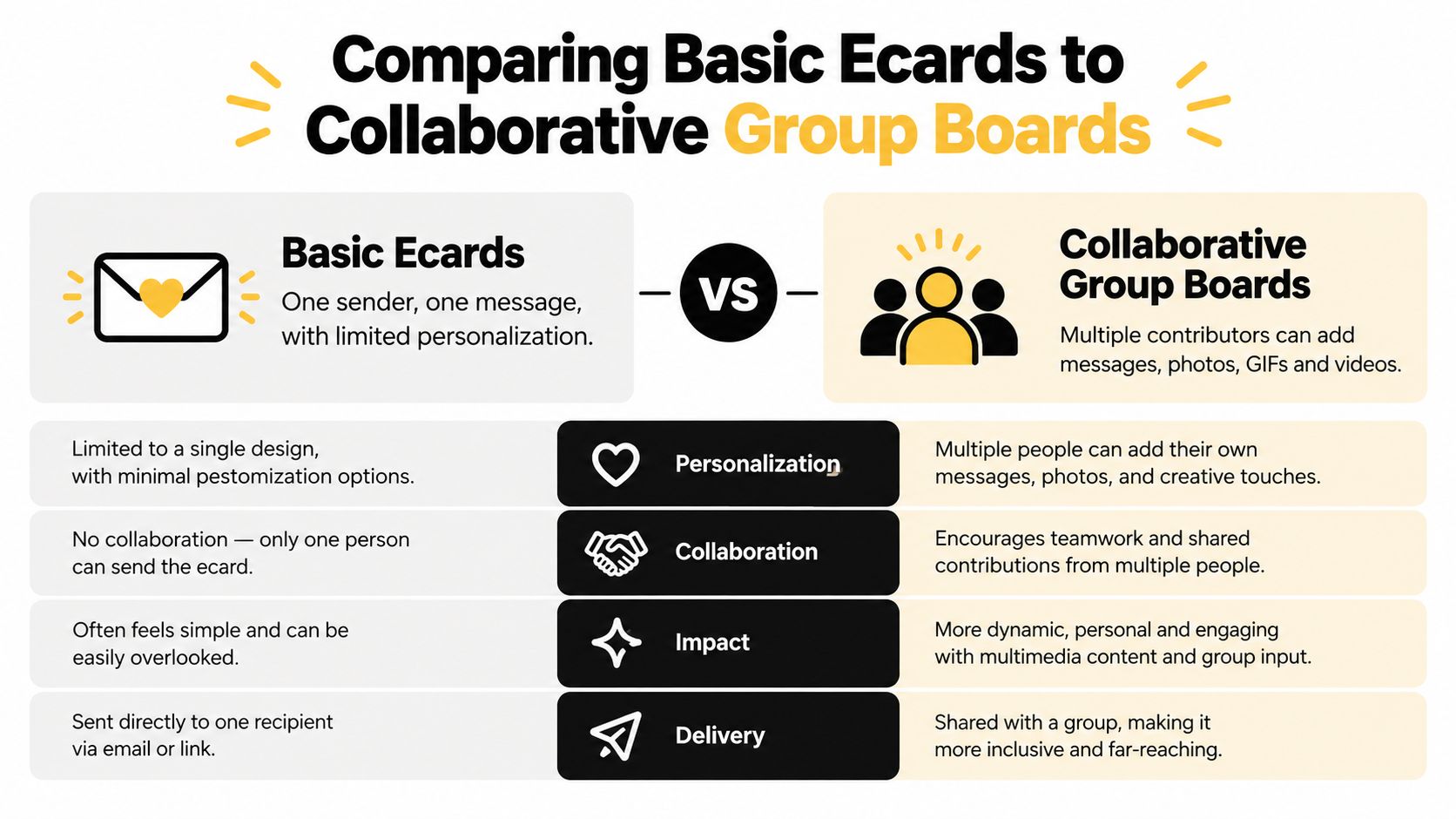
| Feature | Basic ecard | Collaborative group board |
|---|---|---|
| Sender | Usually one person | Several contributors |
| Personalisation | Template, text, and sometimes an image | Individual notes, photos, GIFs, videos, and signatures |
| Team involvement | Limited | Designed for shared participation |
| Best suited to | A quick individual greeting | Farewells, milestones, appreciation, and group occasions |
| Final experience | One message delivered digitally | A collection of contributions in one keepsake |
The difference becomes clear with a birthday. A birthday ecard from a line manager may be warm and appropriate, especially when the message needs to be sent quickly. A group online card allows the wider team to add specific memories, inside jokes, photos from shared projects, or short video greetings. The recipient can see who took part and how each person chose to express themselves.
The same applies to a farewell. A single animated card can say goodbye, but it can't easily capture the different relationships within a team. A group greeting card lets a close collaborator write a personal note, a senior leader add recognition, and newer colleagues contribute their own thanks.
Use a basic ecard when one person owns the relationship and the message is the main point. Use a collaborative board when the occasion belongs to a team, department, class, or community.
A collaborative format also suits multiple recipients. A school might gather messages for a teacher, a nonprofit might recognise volunteers, and an organisation might coordinate a group online card across several offices. The board becomes a shared record of participation rather than a decorative wrapper around one message.
Teams comparing products may search for a kudoboard alternative or a groupgreeting alternative. The useful question isn't which brand sounds familiar. Ask whether the platform supports the workflow you need: easy contribution, multimedia content, privacy controls, moderation, scheduled sending, and a downloadable keepsake.
For a practical example, group digital greeting card options can help culture leads think through whether a simple ecard or a collaborative board fits the occasion. The right choice depends on the emotional importance of the moment and the number of people who should have a voice.
A successful digital card doesn't require a complicated campaign. It needs a clear owner, a sensible deadline, and a contribution process that respects how people work. The organiser should be able to set up the card, share one link, review what arrives, and deliver the finished result without chasing every colleague individually.
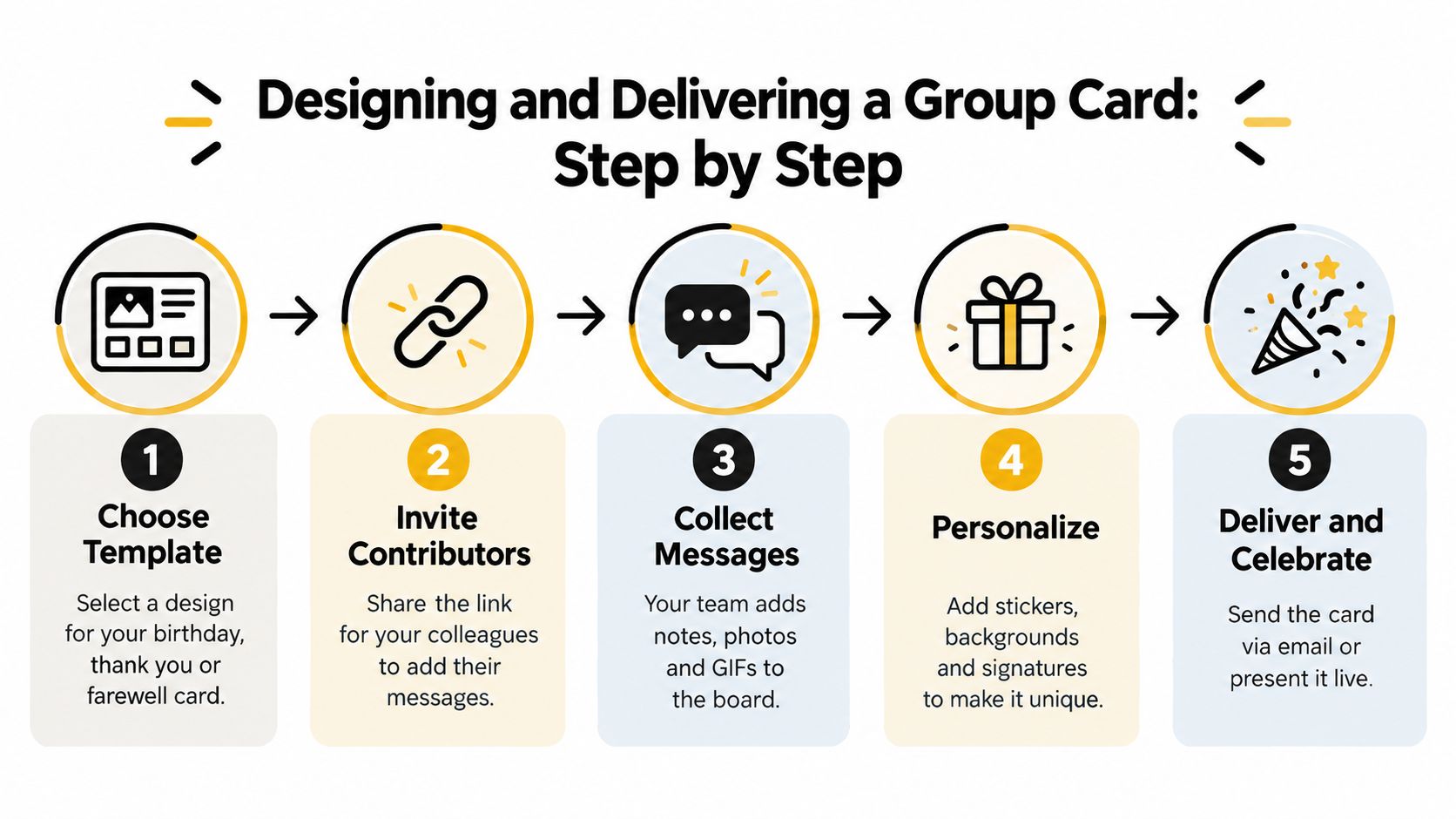
Choose a design that matches the moment, whether it's a birthday, thank-you, farewell, anniversary, or appreciation message. A virtual leaving card might use a warm, celebratory design, while a professional recognition card may benefit from a cleaner layout.
Create the board before you need it. Add the recipient's name, write a short introduction, and set a contribution deadline that leaves time for review. If the platform offers multiple recipients, confirm whether one card should go to everyone or whether each person needs a separate version.
A shareable link is usually easier than collecting messages by email. Post it in the team's normal channel, such as Microsoft Teams, Slack, an internal workspace, or a class communication system. Explain what colleagues can add and give them a specific closing time.
Make participation optional but visible. People shouldn't feel pressured to produce a long message, but they should understand that a short note, photo, GIF, or video is welcome. This is particularly helpful for distributed teams where a colleague may not know who else has already contributed.
Moderation protects the quality and privacy of the final card. Look for accidental personal information, unsuitable jokes, duplicated messages, or content the recipient might not want shared widely. Password protection and entry management can help keep the board limited to the intended group.
Scheduled delivery is useful when surprise and timing matter. An organiser can prepare the card early, review contributions, and arrange delivery for the celebration rather than relying on someone to remember at the last minute. Instant sending works better when the occasion is already underway or the team wants to present the card during a live call.
For remote teams, the best workflow is asynchronous during creation and intentional during delivery.
Finally, decide how the recipient will experience the card. Email delivery is simple. A team meeting can make the reveal more communal. A downloadable file gives the recipient a keepsake they can revisit after the event.
When comparing platforms, design flexibility for digital cards can help you assess whether the available layouts, backgrounds, media options, and presentation formats match your team's tone.
Digital cards fit modern work because they remove a coordination problem without removing the human gesture. People already move between messaging platforms, video meetings, shared documents, mobile devices, and online services throughout the working day. Asking them to sign a physical card in one office creates an exception that remote and hybrid teams can't reliably support.
The wider UK behaviour is clear. Online spending accounted for 50.5% of total UK card spending in September 2025, compared with 43.7% in September 2019, and average monthly spend per cardholder on online transactions rose by 16.7% across that period, according to the cited UK greeting-card trends analysis. These figures concern card spending rather than greeting-card participation, so they shouldn't be treated as direct evidence of workplace card usage. They do show the digital environment in which people now expect everyday interactions to happen.
A school, a charity, and a multinational employer may all use digital cards, but their workflows differ. A school may need a teacher appreciation card with family or student contributions. A nonprofit may want a controlled board for volunteer recognition. An HR team may need a farewell process that works across departments and locations.
The shared requirement is access. A contributor should be able to participate without being in the office, attending a meeting, or installing unfamiliar software. The organiser should also be able to manage privacy, deadlines, and delivery from one place.
UK payment behaviour illustrates how comfortable people are with low-friction digital interactions. UK-issued debit and credit cards were used for 31.4 billion transactions in 2024, including 18.9 billion contactless transactions, and 89% of cards in circulation had contactless functionality at the end of that year, as reported by UK Finance's 2024 card transactions update. Payment behaviour isn't the same as emotional communication, but it helps explain why a quick, link-based contribution process feels natural to many users.
Convenience alone won't create meaningful recognition. A poorly chosen template and generic message can feel automated, whether the card is paper or digital. Culture leads should prompt contributors with useful guidance, such as asking for a specific memory, a thank-you, or a wish for the next stage.
The strongest digital cards combine flexible participation with a deliberate moment of delivery. That might mean presenting the card in a team call, sending it at the start of a colleague's birthday, or giving a departing employee time to read the messages privately.
Accessibility belongs in the design from the start. UK digital platforms should work towards WCAG 2.2 AA expectations and publish an accessibility statement. Public-sector services must also make content perceivable, operable, understandable, and durable under the UK's accessibility regulations, as set out in the GOV.UK accessibility requirements. For a card interface, that means considering keyboard navigation, readable contrast, meaningful labels, and screen-reader compatibility.
A digital card becomes more valuable when the final result survives the delivery moment. The recipient may want to download a high-resolution keepsake or PDF, revisit a slideshow, or keep the messages alongside other personal memories. That turns a short workplace ritual into a record of relationships and appreciation.
Firacard supports collaborative digital greeting cards where people can add text, photos, GIFs, and videos through a shared board. Its plans include a Free option for small groups, Premium for larger contributions and added features, and Infinity for unlimited contributors. The platform also offers password protection, entry management, scheduled delivery, multiple-recipient workflows, slideshow export, and bulk options for organisations.

For HR and People teams, the operational benefit is straightforward. One board can replace scattered email replies, separate image files, and last-minute copying and pasting. Contributors can participate asynchronously, while an organiser retains control over what appears in the final card and when it reaches the recipient.
That makes the format suitable for an online leaving card, a digital leaving card, a sorry for leaving card, a birthday ecard, or a personalised ecard for recognition. It also supports bulk group greeting cards when a school, company, or community organisation needs to coordinate several occasions.
Environmental considerations may matter too. Firacard says each paid card supports tree planting through its partnership with One Tree Planted. That doesn't replace broader sustainability work, but it gives organisations a way to connect a digital recognition ritual with an environmental contribution.
The cultural question should come before the software question. If you're reviewing recognition practices, culture-fit assessment tips can help you consider whether an initiative reflects the values, communication habits, and inclusion needs of your workforce. A card platform should support that work, not substitute for it.
A useful overview of Firacard can help teams assess the practical workflow, from launching a board to inviting contributors and preserving the finished card. The platform is one option among several, but the underlying principle is broader: recognition works better when participation is accessible, personal, and easy to coordinate.
The next time a colleague is leaving, don't ask one person to carry a paper card around an emptying office. Create a shared space, give people room to contribute in their own way, and make the delivery feel intentional.
Firacard lets teams create collaborative group greeting cards with messages, photos, GIFs, videos, scheduled delivery, and downloadable keepsakes. Visit Firacard to create an online leaving card, birthday ecard, or personalised group card for your next remote or hybrid team celebration.


Finding the right words for a 50th birthday can feel oddly difficult. You want to honour a major milestone without making the message sound like a
You've just heard that someone you care about has lost a parent. The funeral is approaching, friends are scattered across cities, and nobody w
You can have hundreds of friendly contacts and still feel unsure who would answer when life gets messy, so what makes a friendship good, and how ca